Diego Garcia-Camargo
Seven Things I learned about Humility While Walking the Camino
On the Camino de Santiago, a conversation between pilgrims never fails to land on the question: “Why are you walking?” Many search for healing, direction in their careers, or simply for a vacation. When I left to Spain for a Camino after graduating from Stanford this year, I didn’t have an answer to that question. As I walked though, I began to see my “why” in the love of Jesus as he washed the feet of his disciples:
“Now before the Feast of the Passover, Jesus, knowing that His hour had come that He would depart from this world to the Father, having loved His own who were in the world, He loved them to the end.
And during supper, the devil having already put into the heart of Judas Iscariot, the son of Simon, to betray Him, Jesus, knowing that the Father had handed all things over to Him, and that He had come forth from God and was going back to God, got up from supper and laid His outer garments aside;
and He took a towel and tied it around Himself” (John 13:1-4).
At the end of my Stanford degree, I felt like I had the world in my hands. I was secure in my relationship with God and was seeking to Love Him with the next stage in my life; I had made dear friends at Stanford and made the most of the last moments we had together. With the experiences and opportunities I’d received, I felt that God had handed my entire life to me on a silver platter and said “you are free to do whatever you will.” In the midst of this I was struck by a single thought: when Jesus held His own life in His hands and was free to do whatever He willed with it, He made himself the lowliest slave and loved His friends in a radical, life-changing way.
What I discovered on the Camino was a deep desire to understand the kind of heart which loves in the way that Jesus loved in that moment, and a desire for my own heart to love like His. In a word, to love like the humble heart of Jesus.
I hope the following reflections help illustrate the journey that helped me start to understand this. The italicized portions are drawn directly from the journal I kept at the time.
0. The Way
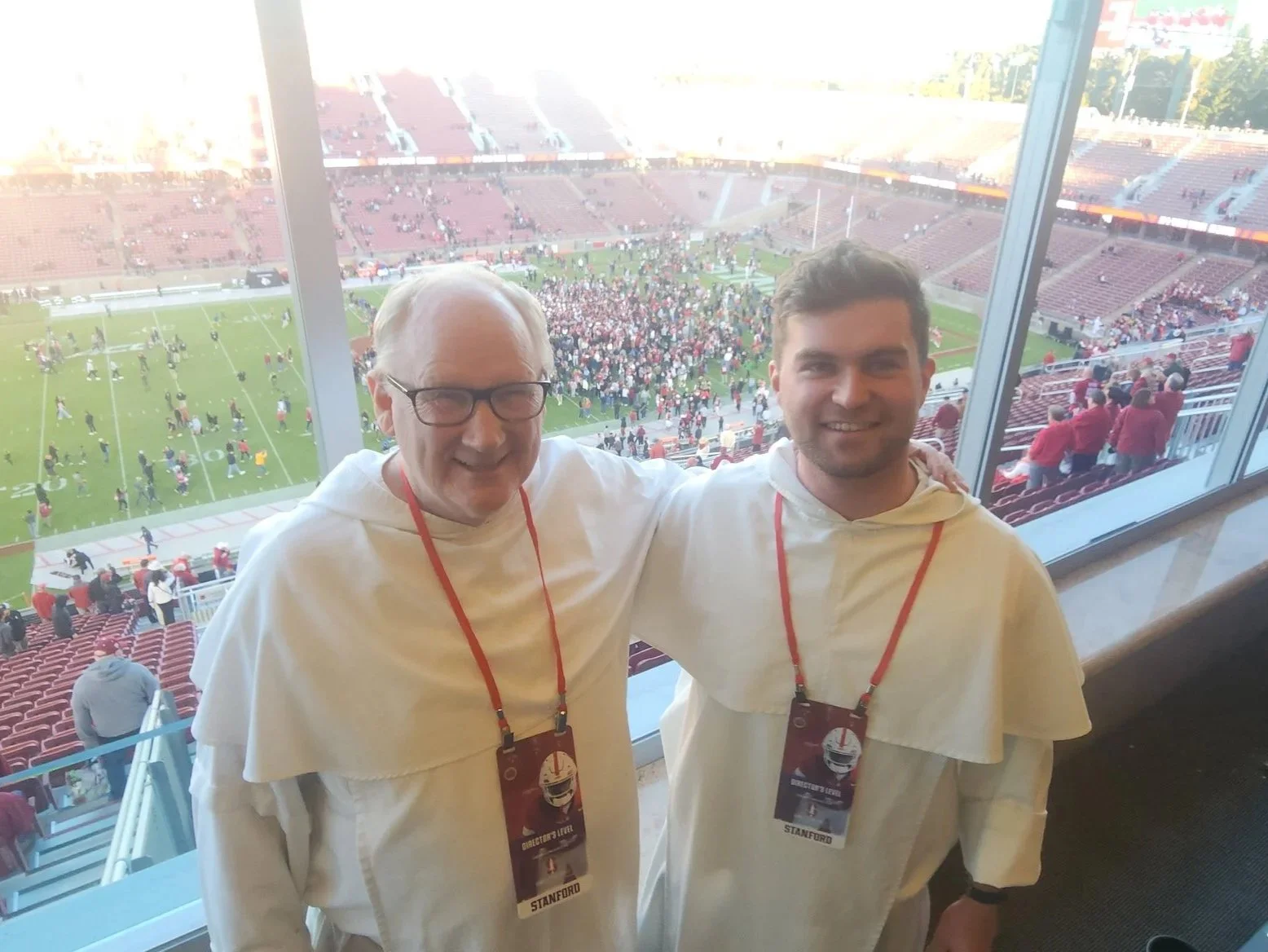
A few months before graduation I feel a serious need for God to intervene in my life plans. I get in my car, go to adoration, and ask two men—a dominican and his friend—to pray over me when I arrive.
As they place their hands on my shoulders, three Carmelite saints: Thérese of Lisieux, Teresa of Jesus, and John of the Cross are close to my heart. We pray for their intercession. We also ask Mary to draw me close to Jesus in this prayer.
Then, in the midst of prayer, one of the men shares a message the Holy Spirit is prompting in him: “You need to meditate on the humility of Mary in the mysteries of the rosary. Meditate on Mary and Joseph—in giving up everything to follow God they became the holiest persons ever.”
I resolve to pray four rosaries every day when I walk the camino that summer. He ends our prayer by saying “Our Lady of Mt. Carmel, pray for us.”
1. Don’t delay the will of God
It’s two days after graduation and a French-Canadian steward speaks a curt greeting as I ambulate down a pale jet bridge. I grumble in my plane seat because my Roman vacation has been cut from my travel plans. The purpose of my journey is to make a pilgrimage, but is a few days of fun after four years at Stanford too much to ask?
Baggage processing is abysmal at Rome’s Fiumicino airport and I miss my flight. When I rebook, I wince at dropping another $150 on tickets to Spain but the thought of arriving in Spain starts to get me excited.
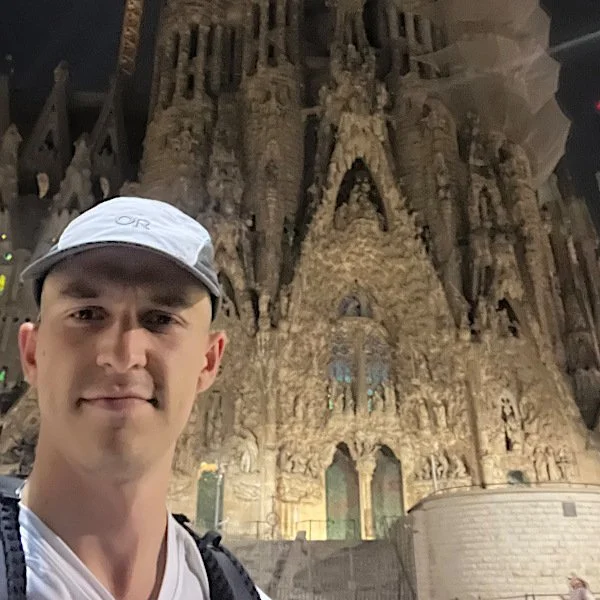
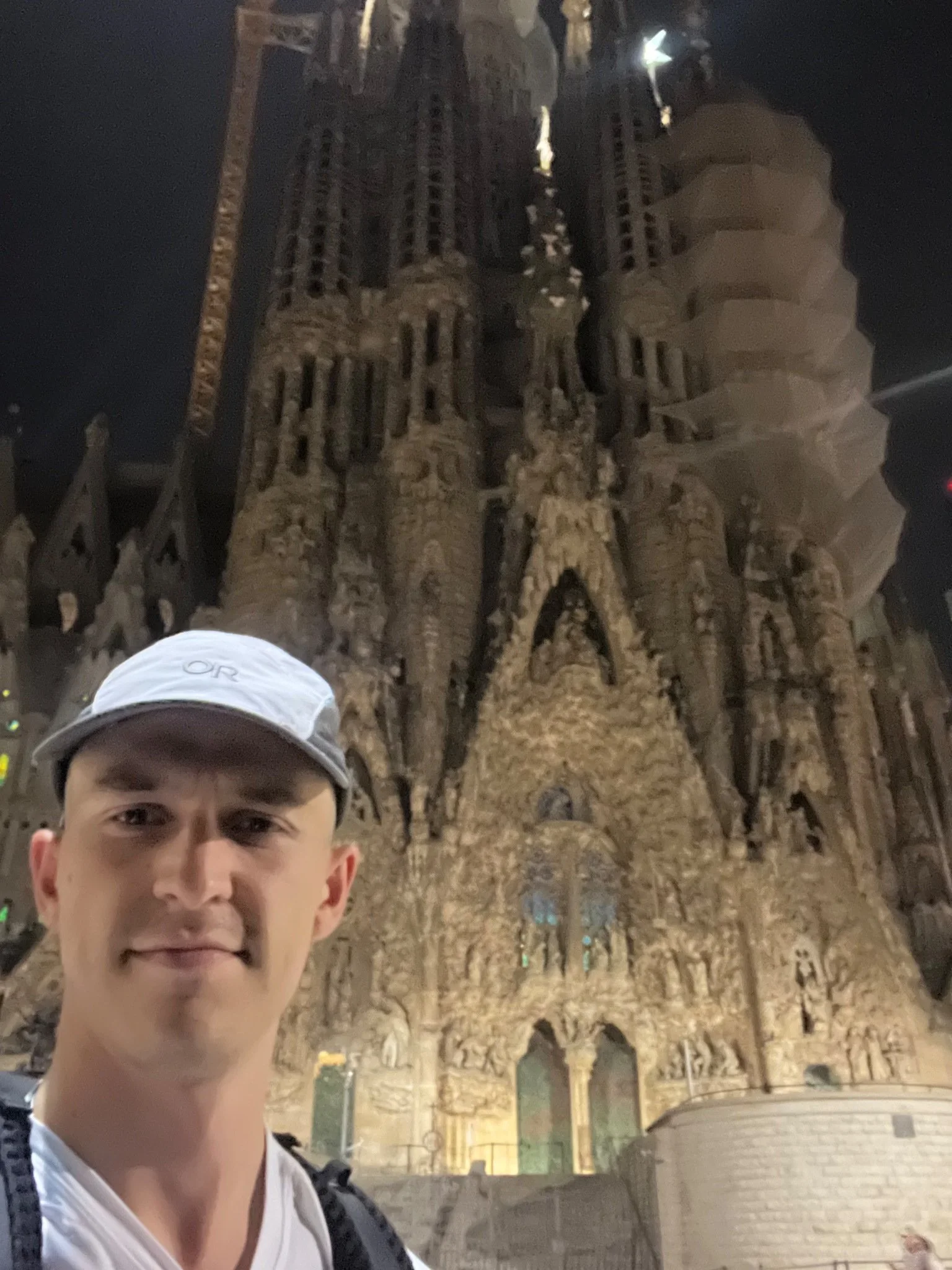
A rush of humid air greets me when I finally arrive in Barcelona. Despite my midnight landing, I sprint to the last metro that will take me to see an illuminated Sagrada Familia—it towers like a wild forest rising out of pavement. Eventually, I find a hostel and rest.
The next day, I visit Marcos in Zaragoza on my way up to St. Jean Pied de Port; he shows me the basilica of Our Lady of the Pillar.
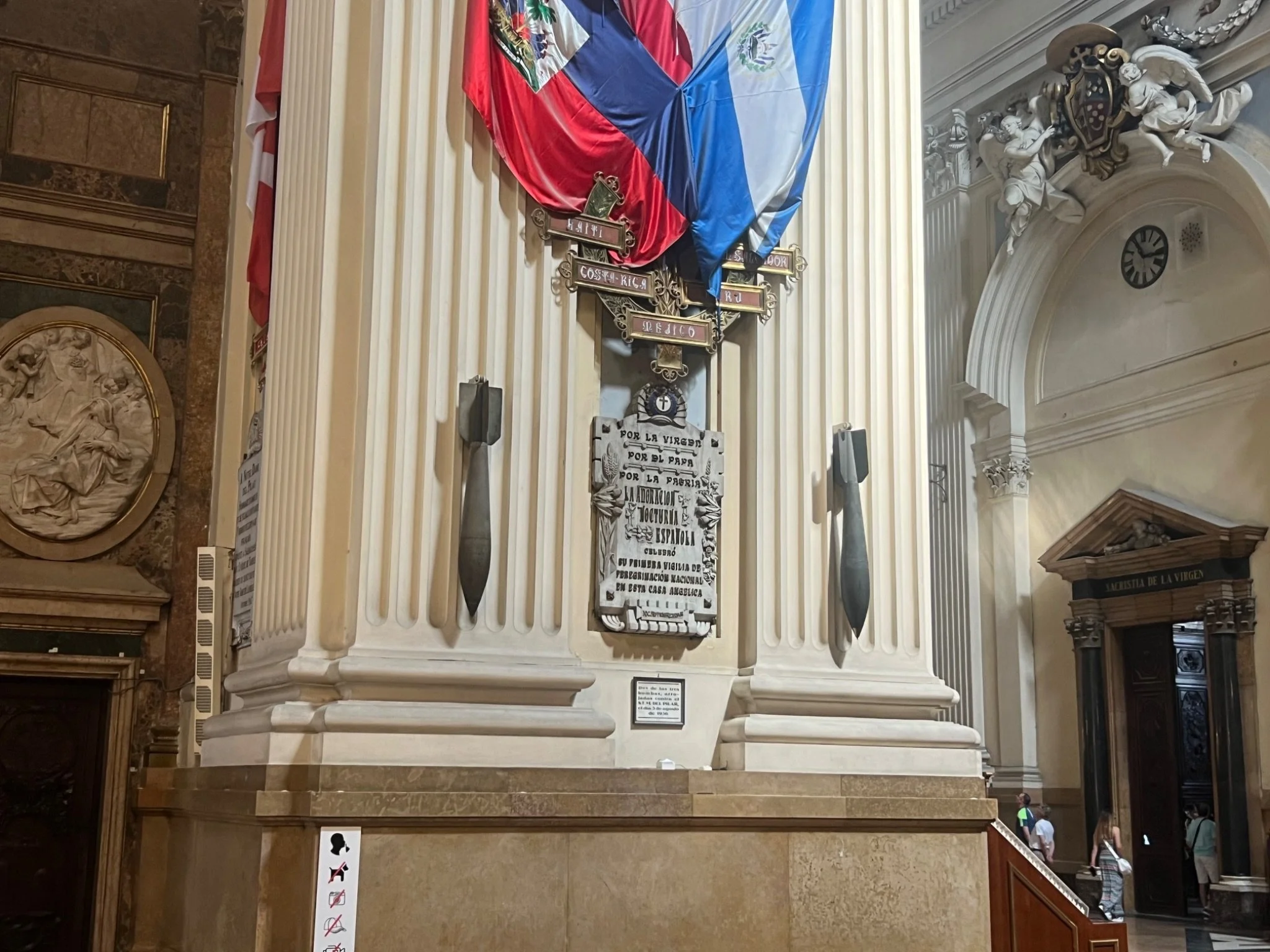
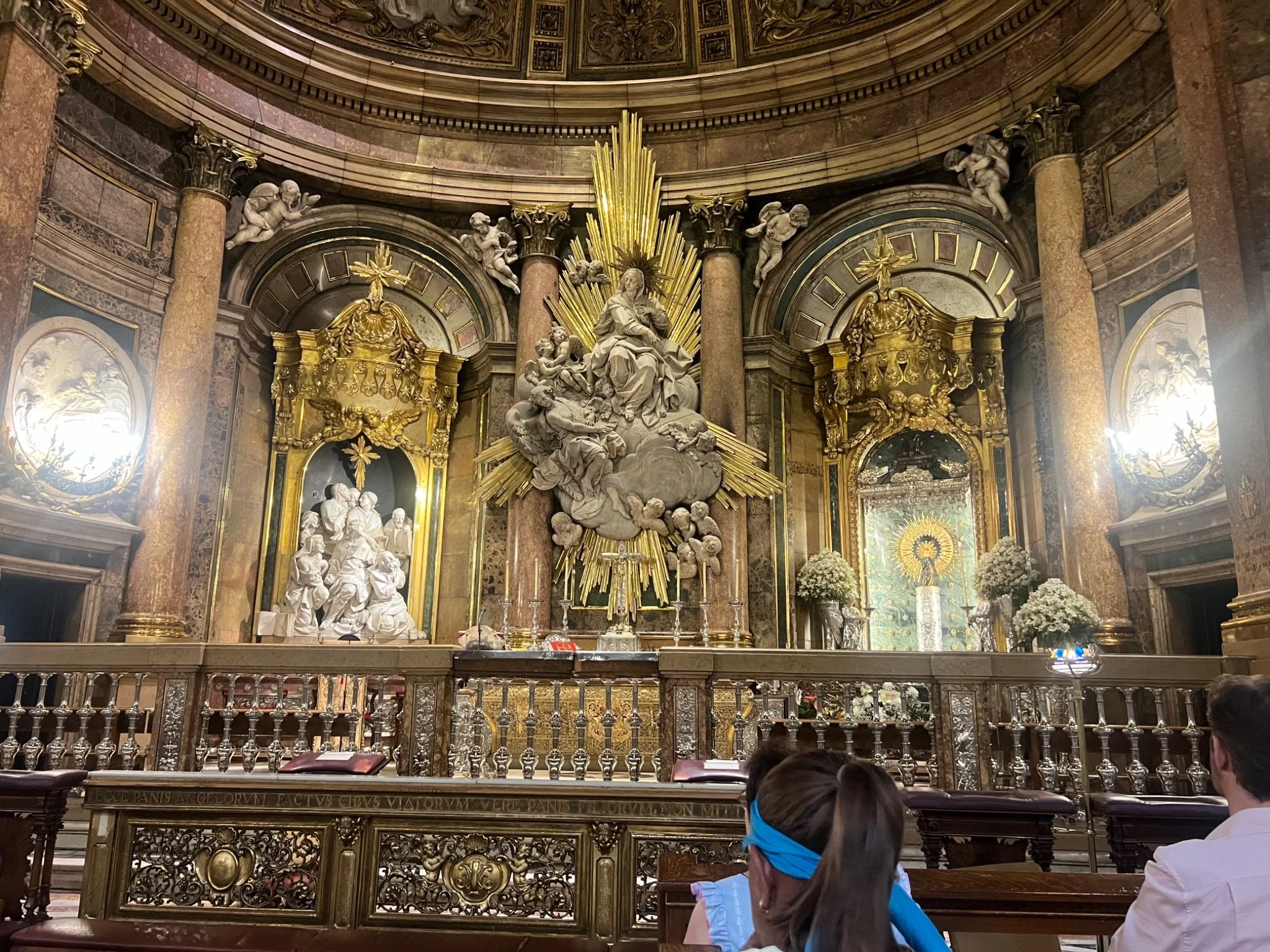
The ceiling of Our Lady’s temple shows a disfigured image and a gaping hole. If you look at the pillar to the right of the Virgin’s chapel, you can see two oblong green bombs—the culprits of this sacrilege. Tens of hundreds of bombs were dropped on Zaragoza during the civil war. Tens of hundreds of bombs explode. Only two ever land in the Cathedral. Both bounce off the floor, duds. The house of Mary and her people was safe.
I pray in that chapel that the bombs never touched…
I wanted to tour more and then begin later. I wanted to see more of Europe. For me to enjoy, for others to know that I enjoyed it.
I spoke to Mary in the baptism of Jesus and asked her about sacrifice. The sacrifice of her son leaving their home forever. The separation and distance she would need to accept for His sake and the sake of the whole world. How did you accept that sacrifice? How did you live it? What do I need to learn here?
She said that it’s not about you. You can’t walk for yourself.
You need to pray the rosary for a lot of people while you walk.
Afterwards I reflect on my experience arriving into Europe.
I notice the spirit of delay is not from God. It is what Paul warns against: to not let even good things distract you on the way if you are doing something for the Lord. I resolve to go directly to Pamplona and then St. Jean de pied port.
2. The Walk from Scrupulosity to Repentance
I feel like I’m going to throw up. I feel like I’m going to explode.
After a week with old and new friends on the Camino, I take an extra day to explore Santo Domingo and must walk to Burgos alone. In the silence, a guileful voice begins to whisper accusations in my mind.
Guilt pierces my thoughts. Embarrassment is like a thousand thorns on a vine; with each step I become more and more aware of their entrenchment in my heart.
My travels heave against these vines of scrupulosity and with each pull temptations to despair, fear, and mistrust oppress me. I’ve walked twenty miles and I am exhausted: spiritually, physically, emotionally.
That evening, I call my father and we say a short prayer; the next two days are a bit more bearable.
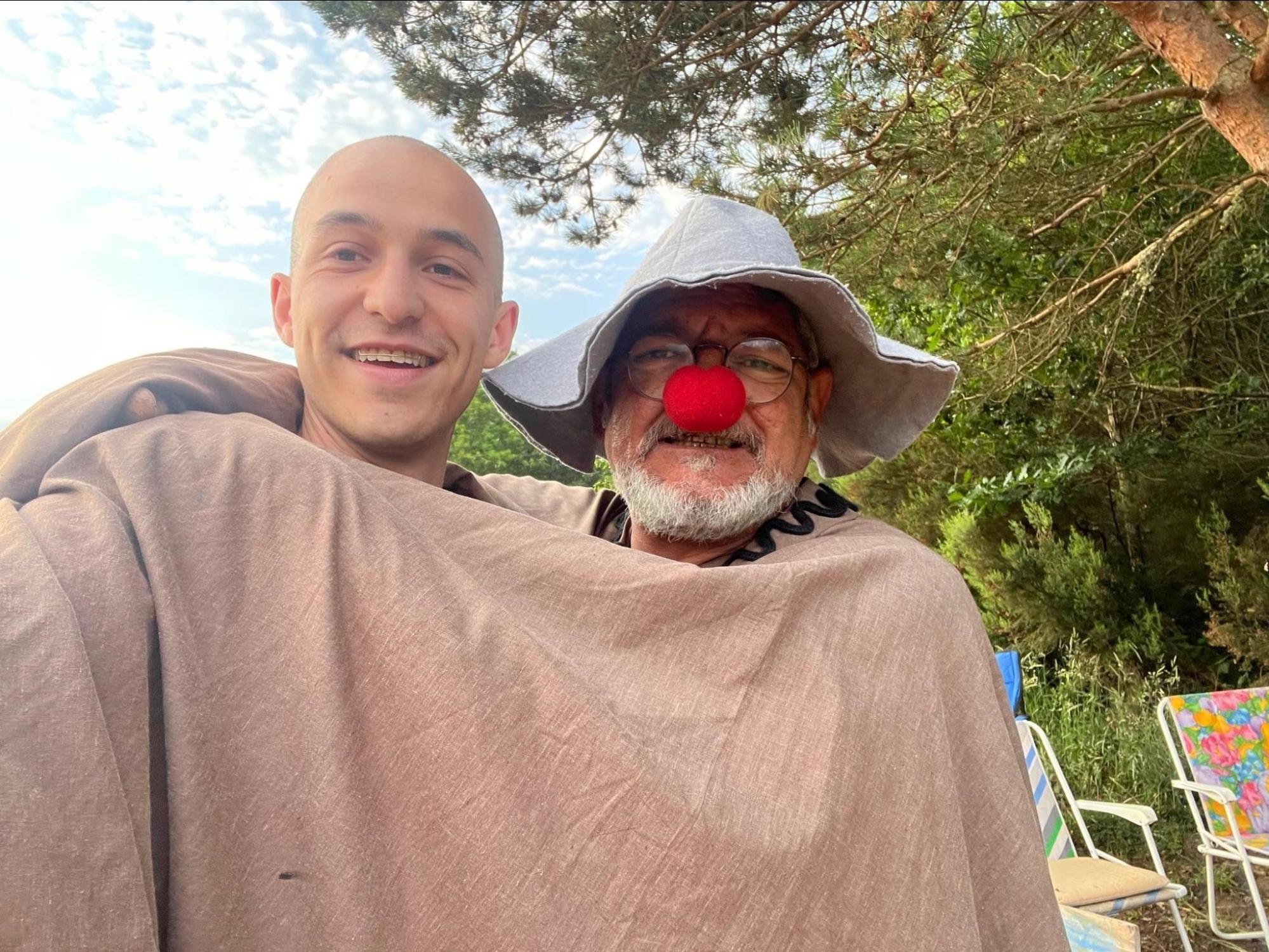
In Burgos, I meet a clown who makes me laugh harder than I’ve laughed in weeks. I reunite with my friends for the last time. We explore the city over a few pints and dance at a local salsa festival. I meet some of my Spanish family for the first time and a dear friend from San Francisco arrives—we spend the day in the cathedral. These welcome consolations begin to turn me around.
Rays of light fall through the misty church of San Lorenzo. A warm grace fills the nave and colors the statues gold. I see the warmth, but it still feels beyond me—the air is crisp and the marble cold. I ask God for his mercy and sit on the stone floor before a statue of Joseph holding the infant Jesus.
Like a child peering through a window, an elderly priest with joyful cheeks leans toward me. His name is Padre Jesús María. He’s removed the screen from his confessional; there is no anonymity with him. Once a prolific missionary, illness and age caught up with him, and he was charged with this small parish of San Lorenzo in the city of Burgos.
As seems to be his custom with pilgrims, Padre Jesús tells me a long story before confession even begins.
While on a mission in South America, a Franciscan friar once shared with him what he believed was the essence of Christian life: ir de la indigencia a la trascendencia—to go from indigence to transcendence. That is, to experience God working through our very limitations and destitution. At the time, Padre Jesús didn’t understand (neither did I) so he told me another story.
Years later, three young women entered his church of San Lorenzo, all dressed for the club. Dark makeup, sequins, everything. They approached him to ask about a particularly strange carving on one of the gold altarpieces. Explaining that it was a representation of the trinity, he told them of the inner life of a God who is Love, a Love that invites us into His own life. They were amazed.
Hours later, one of the young women returned and knelt before that image, visibly moved. She had gone to Catholic school as a girl, where she learned much about justice but had never heard the transcendence of God, a God who is Love. A God who invites her simply to be loved by Him. She thanked the priest and left.
The doctor of souls then ended his tale to look at me very pointedly as if to say this answered the Franciscan’s riddle. Then he hears my confession and very simply explains how to conquer my scrupulosity:
Judas was scrupulous.
Peter was repentant.
Be humble, like Peter who says: “Lord, You know! You know that I love You! You know I have sinned, that I’ve failed, that I’ve done good. You know everything! You know that I love you!”
After giving me absolution, he asks me to pray to Saint James when I arrive in Santiago—to pray for the ailing old priest who cares for the church of San Lorenzo.
I say I will.
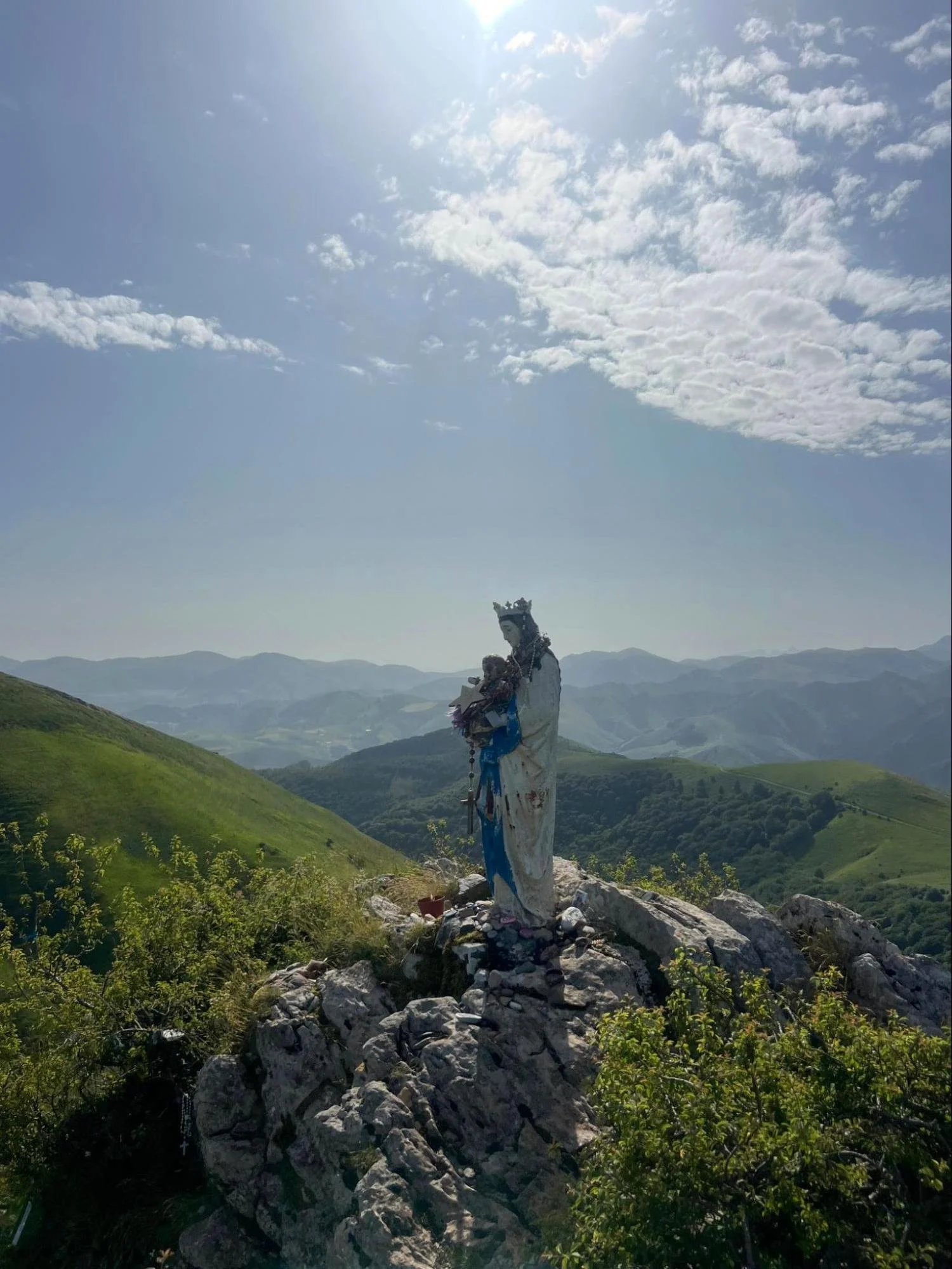
3. Creation is a miracle
Listening to a podcast on my walk, I hear a Dominican say that the key to a peaceful and authentic humility is to know the answer to the questions What am I? and What am I for? For me, these questions become like lighthouses in the open sea.
I put life against these lighthouses and begin to ask what in my heart distinguishes humility from pride. The following is a reconstruction of a long section of journaling I did that day.
In humility, the concern is to be what you are and do what you are for. So, real attractiveness—the kind that has some substance behind it—seems to lie in the quiet magnanimity of being the person or thing you are and knowing the purpose that lies within that. Like an acorn knowing it is just a tiny acorn and recognizing it has the calling of a mighty tree.
I think old ladies illustrate some part of this. The wrinkles of a woman’s face are like many cracks and shades and shadows of the life she’s lived. Each of the small folds are like a relief carved out of the pure potential of youth—the same fire of life still living behind her eyes. In her very skin she shows the beauty of being who she is.
Maybe the attractiveness of humility is just this kind of beauty, overflowing from the life lived in an old lady’s wrinkled skin—an ordinary person being herself. This beauty isn’t ostentatious, but it is undeniably real.
It is ordinary and real but it isn’t harmless. If you really reckon with the life she’s lived, you will quickly find out: this woman is a mother. Her beauty has suffered for others, and it wounds with the transcendent glory of God.
Let’s return to a tree. Like a woman’s wrinkled skin, the bark and branches hide a secret about life itself. In the nooks of the branches, you see patterns of fractals—infinity hidden in a tiny space. It makes me wonder why the tree is. Upon pondering this question under the cover of its branches, the tree reveals its secret in a piercing moment.
It is a moment of electric being. When the finite tree explodes in an effervescent fluorescent burning chemical fire. The beauty revealed makes the colors of the leaves and the bark too bright for our hearts to ignore. Van Gogh saw this in his Mulberry tree.
In this revelatory moment, the beauty of the tree is apocalyptic. Its existence is revealed as utterly beyond our poor power to comprehend. We are thrust into fear in the face of this burning bush, this fiery tree. We could never conceive of ourselves; we could never create ourselves. The words I AM overcome us like tsunami—an uttered wave—but WHO AM suggests a person and our fear turns to wonder: the bush is not burnt to a crisp by the fire of this Beauty.
Even if the tree burns wildly with the indication of I AM WHO AM, the tree is still there, and wonder becomes the basis of friendship.
Maybe it’s that the beauty of humble things lets God shine forth in this way. So that as soon as you are attracted by beauty—the moment where God is revealed—you can lose sight of the reason for this beauty: humility. In other words, the tree is just a tree. The acorn is just an acorn. The old woman is an old woman. And we see that it is good.
A priest once told me to meditate on the greatest humility in the world. That behind the doors of the church, within a small metal box, on a small metallic throne, God himself resides.
That He dwells, appearing as a piece of bread, so I can be with him.
4. God in the Ordinary Things
After many days of walking alone, silence begins to have more substance. It’s not simply the absence of noise, but a canvas upon which my thoughts become a dialogue with God’s.
One afternoon, I decide to stop and buy some souvenirs at a Benedictine monastery. A German monk sells me the holy wares and convinces me to stop my journey for the day and stay in a hostel nearby. The prettiness of this town and his peer pressure are enough to convince me.
At the hostel, fourteen pilgrims converse like family, gathered over afternoon tea. Our hosts are three Edinburgh natives: Susan, Jim, and Sallie. At my arrival they take my bag and hand me a ceramic mug with steaming liquid. It’s strange, we are all foreigners in this place but I feel at home as I learn about the dreams and hopes of these Scots, Canadians, Koreans, Dominicans and Spaniards.
Susan and Sallie are sisters. Like tías from Mexico, they hang on to every word about my life, laughing in soft tones at my stories from Senior year. Jim, Susan’s husband, accents our conversation with short stories from their Camino: a wondrous sunrise over Santiago as they finish, the perfect seats in Santiago’s Cathedral for the mass, and the most delicious Galician squid at their favorite restaurant in Melide.
We all join the monks at the ring of the bells for evening prayer. On my way out, I stop the Benedictine priest for confession. He’s young, born and raised in South Korea, and seems to laugh as though he knows some special trick that is in store for me—some good secret, to be divulged freely when the time is right.
After I confess my sins, he tells me.
“Do you see Saints and Angels on the Camino?”
I shake my head no and see his eyes widen.
He gives me an incredulous look and my answer shifts to a confused yes.
“Good,” he says laughing. Then he explains:
“When you walk alone for many miles and begin to wonder if you’re going the right way. Then an old lady says to you, ‘My son, where are you going?’ and shows the right way—Isn’t that an angel?
And when the old man in a town sees your exhaustion and offers you cold water from his home along the path, isn’t he a saint?
And when you forget to bring food for lunch, but the pilgrims around you share and there is enough for everyone to eat and keep walking—aren’t you in the presence of the saints?”
I thank the priest for sharing this secret with me and consider his infectious idea on my walk home.
In the setting sun after evening prayers, the pilgrims gather one last time before bed. After simple conversation, a guitar is procured and I’m asked to play a few songs. A few voices intertwine with mine for a sweet Spanish tune; we don’t know all the lyrics but humming fills the gaps. Eventually, our tired bodies catch up to us and we go to bed.
That night, I remember halos and wings on Jim, Sallie, and Susan; I hear the choirs of the saints in the hums of our gathering that evening.
5. The Moss is Hugging the trees
In the midst of my silent conversations with God, I notice myself holding on too tightly to the esteem and affection of a certain person in my life. I see this attachment keeping me from deeper friendship and deeper love for God. I pray the rosary for clarity, peace, and surrender.
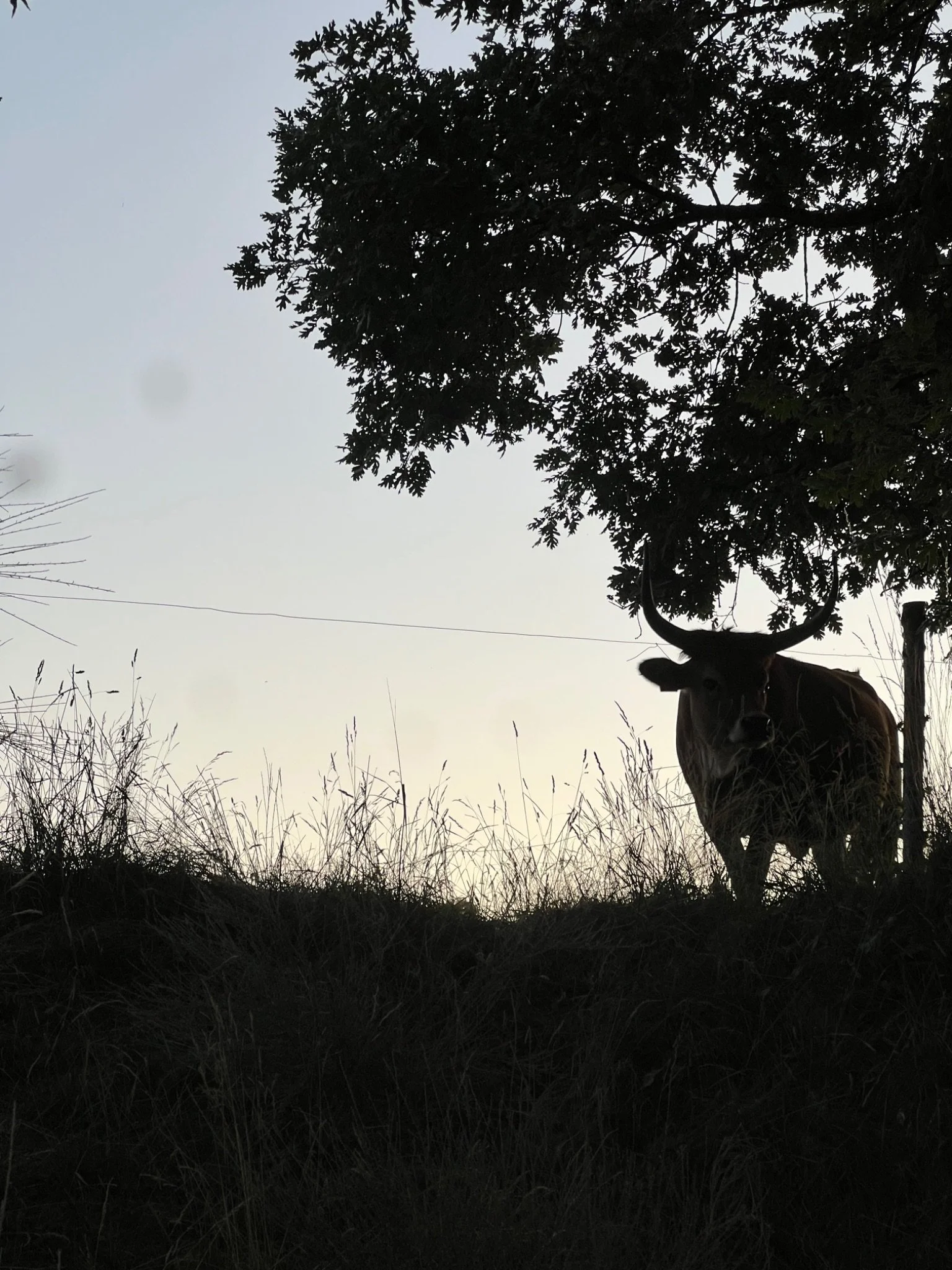
I sit on a low, cobbled wall during lunchtime one day. An elderly couple and their dog are herding a dozen cows using long, thin canes. They urge the cows onwards in syncopated Galician commands and with many, many barks. Over a feast of cheap chorizo and french bread, I watch the dog weave through the herd in fast, bounding strides. It’s a mostly peaceful scene but the struggle to surrender my particular attachment weighs heavy on my heart.
Upon finishing my meal, I feel drawn to prayer. So I close my eyes and make a small act of surrender, asking God for the grace to let go of my desire to be esteemed by this person. I choose to let it go and feel a deep peace.
When I open my eyes again, the beauty of this simple place enters my heart. The herd dog is quiet now. It breaks from its path weaving through the cows and saunters directly towards me. When it approaches me, I put out my hand and it gently lowers its head into my palm for a moment. I give it a soft pat, and then it turns and trots back to its work, barking cows into line once more.
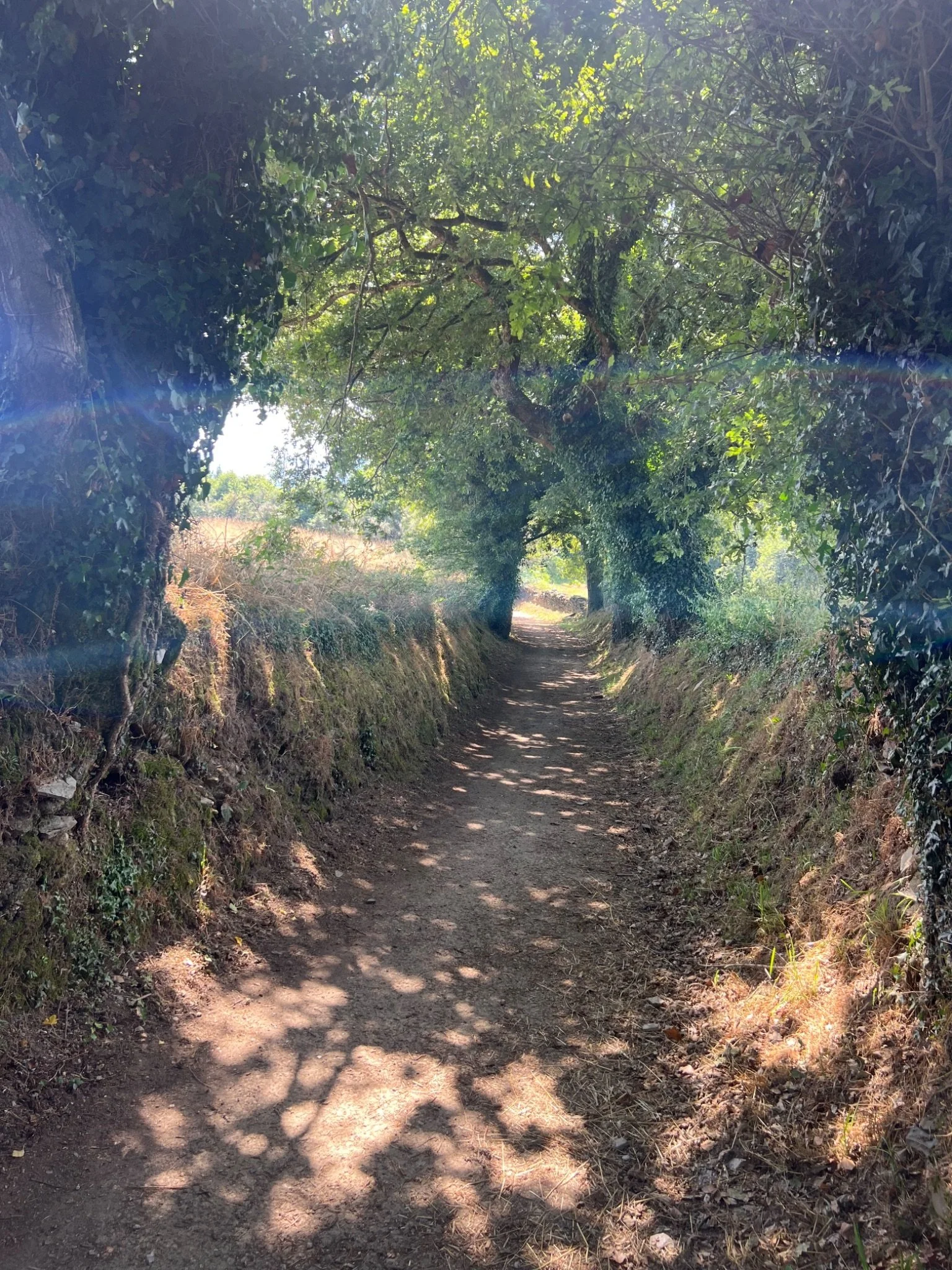
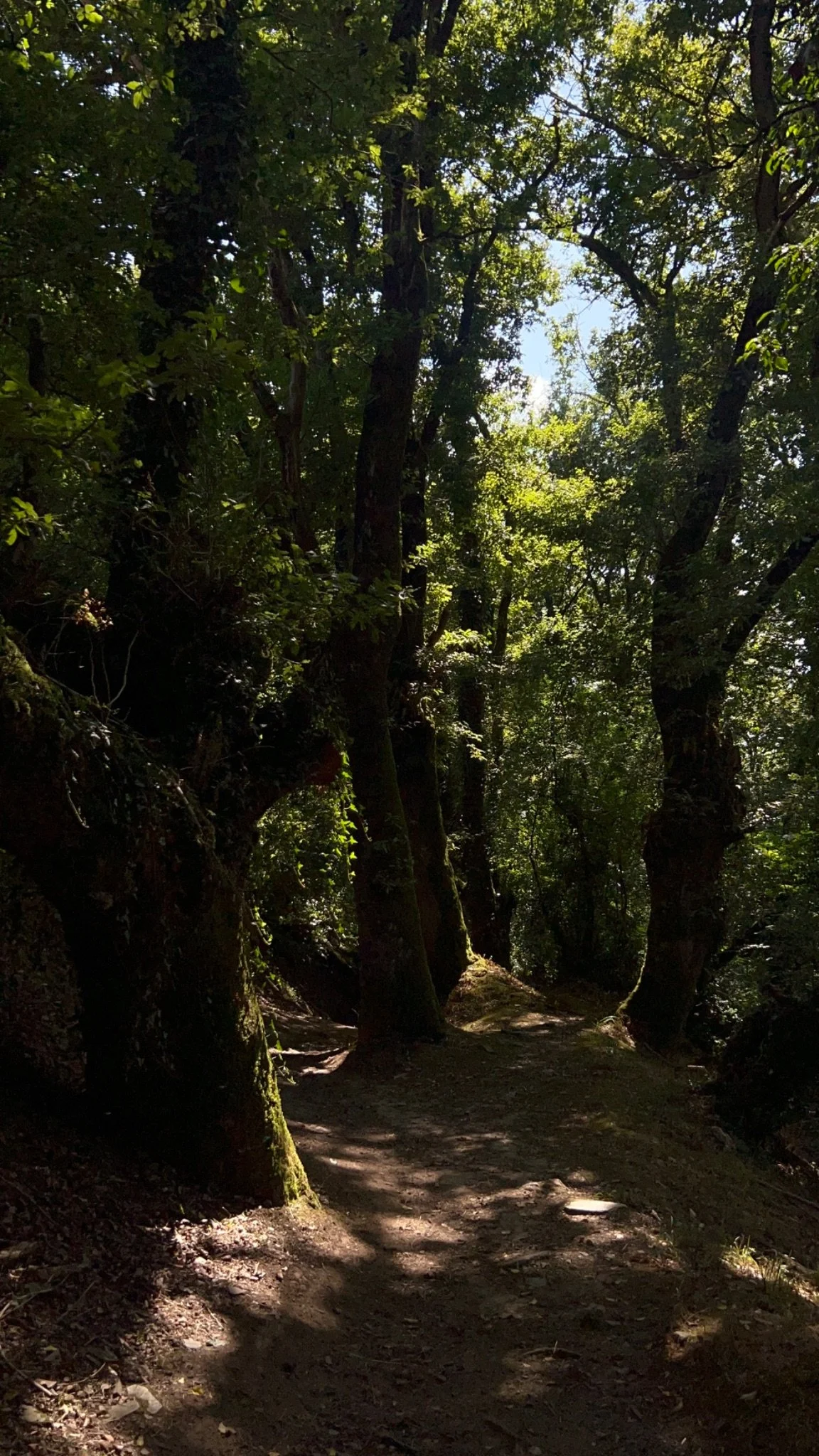
When I start to walk again, the beauty of the earth seems as though it was made for me. The moss hanging off the sides of tree trunks looks like little sisters clinging to their brothers at the waist. Drooping branches above are like hugging arms when I walk beneath them. Their leaves caress the air with flutters and I feel the wax on one of them as if I’m shaking hands with a giant.
Stones stacked on one another are cousins laughing, scheming to roll down some hill. Pebbles in the path are like little boys and girls jostling gently against my soles. The air itself is thick with God’s embrace and it envelopes me completely.
I sit down to pray and journal and end up falling asleep on a big tan rock in the middle of the trail for a few hours that day. The other pilgrims never let me hear the end of it.
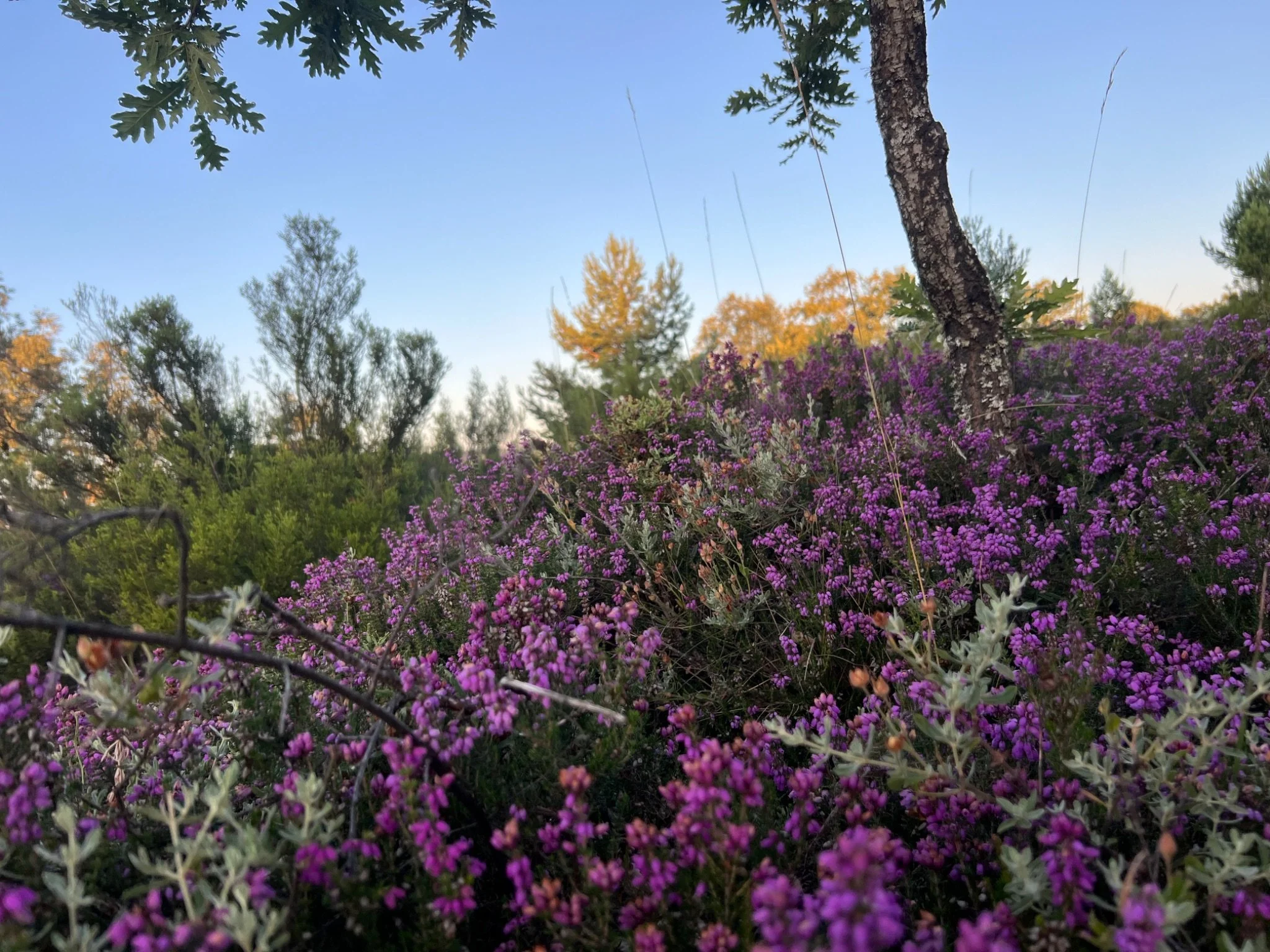
In days to come I am greeted by graceful blue hydrangeas across the Leónian countryside. Green lily pads spot the ponds I walk past. Bouquets of wild thyme and purple heather seem to invite me to some mountainous wedding that I cannot see through the soft rolling fog. I hum an Irish tune to the wild mountain thyme and sing silently to myself, composing a song as I walk the mileage to Galicia.
God loves us with all of his creation. How blind I become when I hold on too tight to one part of it. I felt the embrace of God’s creation. God’s creation, the fact of its existence is like Him embracing us with His love.
6. Sometimes you Have to Sleep in Churches
Midway through the Camino, the mother of a friend back home passes away and I promise them I’ll do my best to win an indulgence for their mom’s soul. Each day I pray for their mother and ask God the opportunity to help win the grace of a fast passage for their soul from purgatory to heaven.
The morning that I’m meant to leave León, I sleep through all my alarms and have to be woken by the owners of the hostel. The late wakeup makes me groggy, anxious, and delayed. It’s the heat of noon when I finally begin walking.
A half mile into my belated journey, my eye is caught by a giant Dominican cross on the front of a building. I try to make myself trudge past but something tugs on my heart and I turn around, deciding to take a look inside.
At the porter’s gate I meet Sister Augustina—a short, grandmotherly woman with a broad smile, a lovely Spanish accent, and a well-pressed, white habit. She explains that this residence serves as a dormitory for university women. When I ask if there is a chapel I can visit, she kindly lets me into a simple oratory where the blessed sacrament is reserved. I settle down in front of a large statue of Our Lady of the Rosary and end up falling asleep.
Around an hour later, I walk out with a red mark on my face and a good bit of embarrassment from resting my head on the pews. Sister Augustina catches me on my way out and pinches my cheeks before I can leave. Her parting comment and jolly laugh cut through my embarrassment: “The Lord must have wanted to spend some extra time with you in León before you kept going on your way.”
With a renewed spirit and trust in God’s plan, I walk onwards. An hour later, my phone dies and I dig through my pack to realize that I’ve lost my charger. All the businesses in the town I’m in are closed until the evening. I won’t be able to buy a charger in the villages to come so I am forced to stay the night in the tiny town of Virgen del Camino where I will purchase a replacement that night. Trying to remain hopeful over this seeming disaster of a day, I check into the only hostel in town and buy some groceries for dinner.
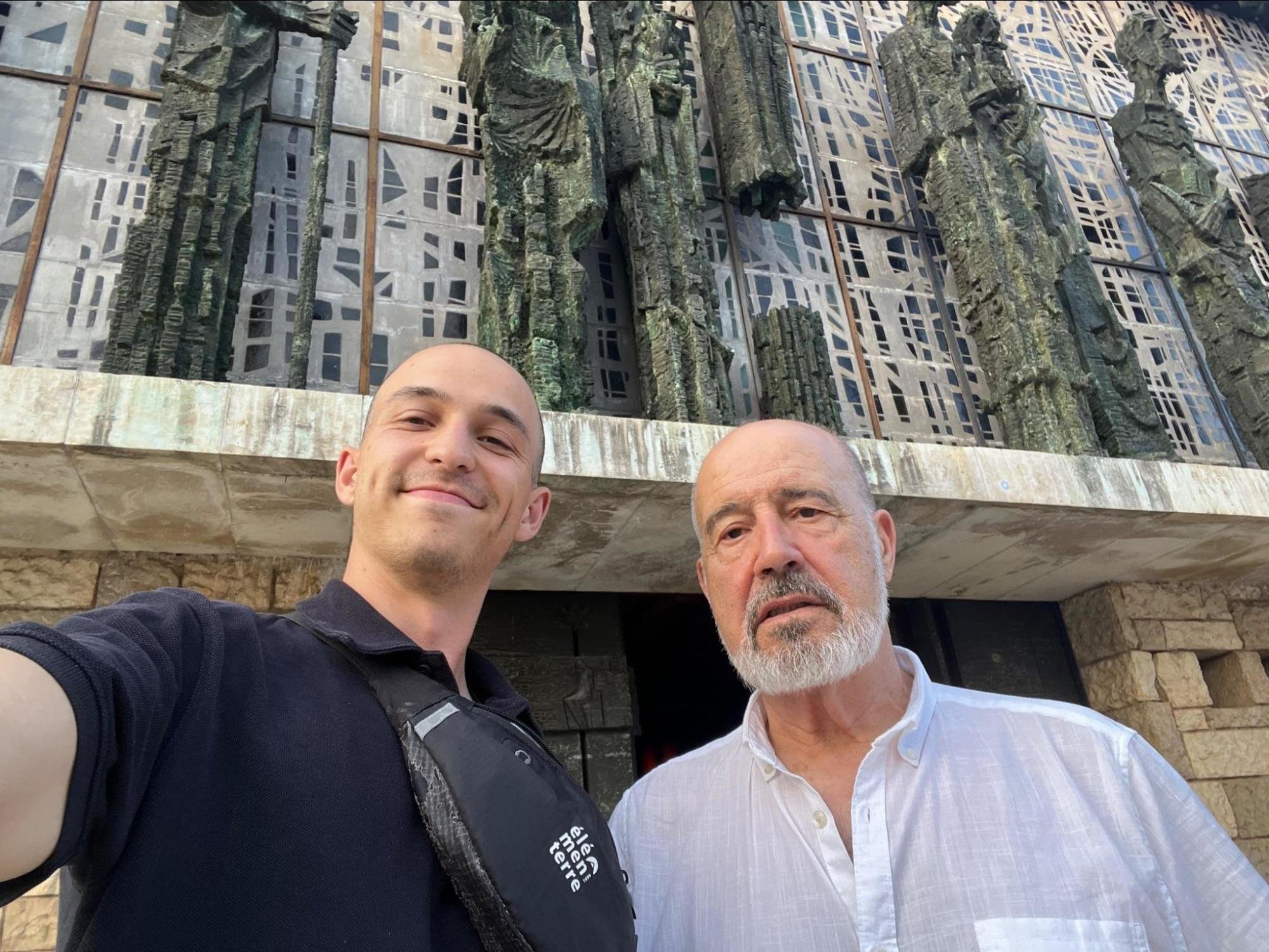
As I explore the town, I happen upon the basilica for La Virgen del Camino—a ginormous brutalist building with a cross at the top and what seem like post-apocalyptic statues of the twelve apostles on its façade. I enter to a large nave with broad, concrete walls and a simple wooden altar. Behind the altar stands an elaborately baroque reredos with many gold and floral accents that seems to defy the brutalist motifs of the church.
In the center of it all, a prominent statue depicting the pieta is enthroned with a beautiful red mantle wrapped around the virgin’s shoulders. A bald man in a Dominican habit prepares for mass at the altar and when mass begins, I learn about the story of this town in Father’s homily.
On July 2, 1505, the Virgin Mary appeared to the humble shepherd Alvar Simón Gómez at the top of the hill upon which Virgen del Camino dwells. Shining with extraordinary light and offering her mantle as a sign of her maternal protection, this Mother promised her intercession for the people of the Kingdom of León. Since then the cult of devotion for this apparition has grown from this town to the whole region and remained fervent for the last five hundred years.
The priest urges us to thank God and realize the immense gift of Mary choosing to reside in this land with the Leonese people, especially as tomorrow marks the five-hundred and twentieth anniversary feast of the apparition of Mary in this place.
After mass, the bald Dominican priest has changed from his habit into a linen shirt and brown penny loafers. His name is Fray Antonio and when I meet him, he jokingly complains about missing evening prayer with his community because of a wedding anniversary he celebrated during the mass. I offer to say evening prayer with him.
Sitting in the mostly empty church, we pray vespers, commiserate about the delays of the day, and have a conversation about my camino. If it isn’t too much of a delay, he invites me to see the large procession that will happen the next day. When I ask him how I can pray for my friend’s mother who had passed, he explains that as Virgen del Camino is a minor basilica, I can win a plenary indulgence by making a visit to this church on its feast day tomorrow. Seeing the hand of providence in my late wake up, lost charger, and midday nap, I accept his invitation.
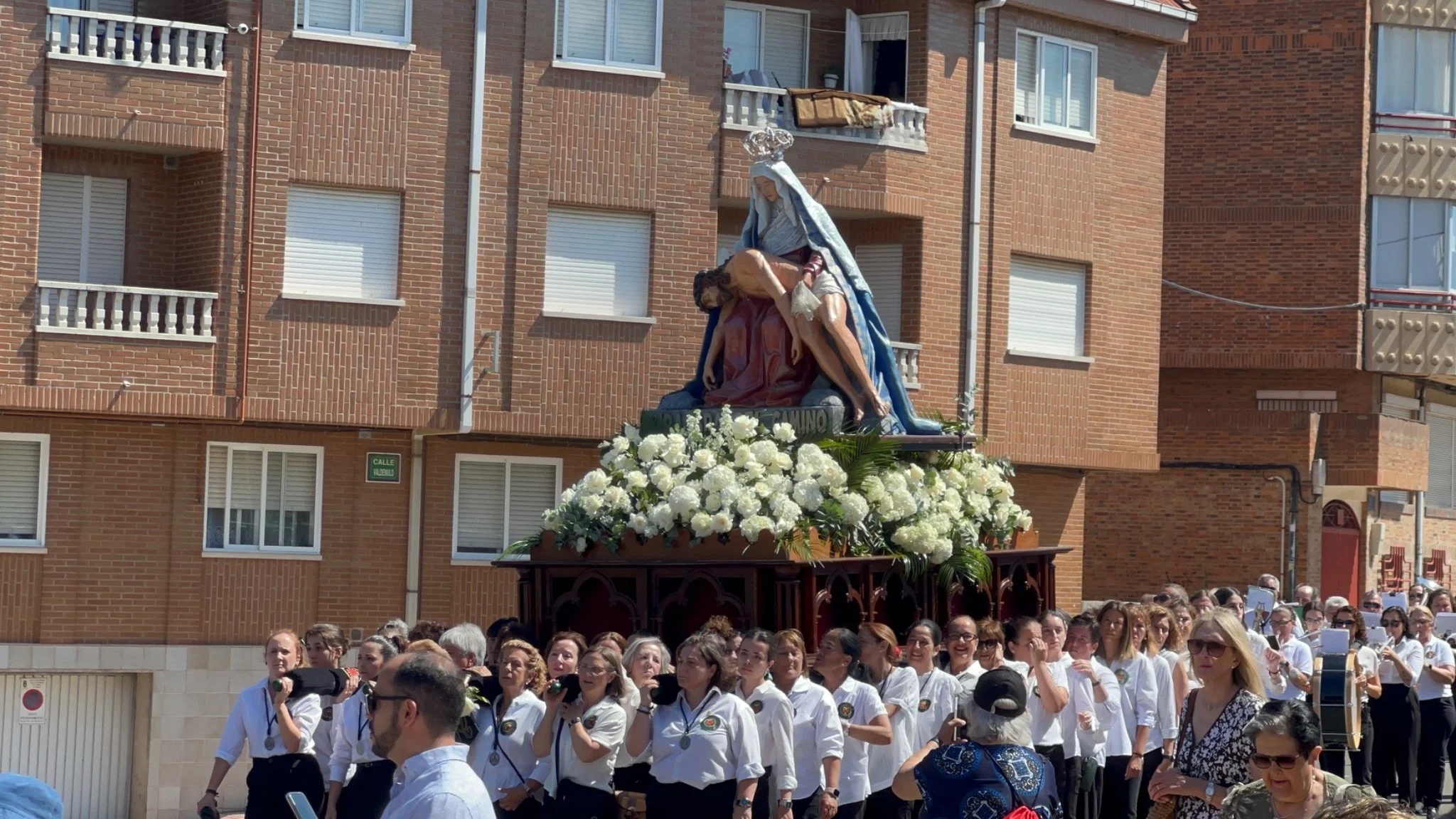
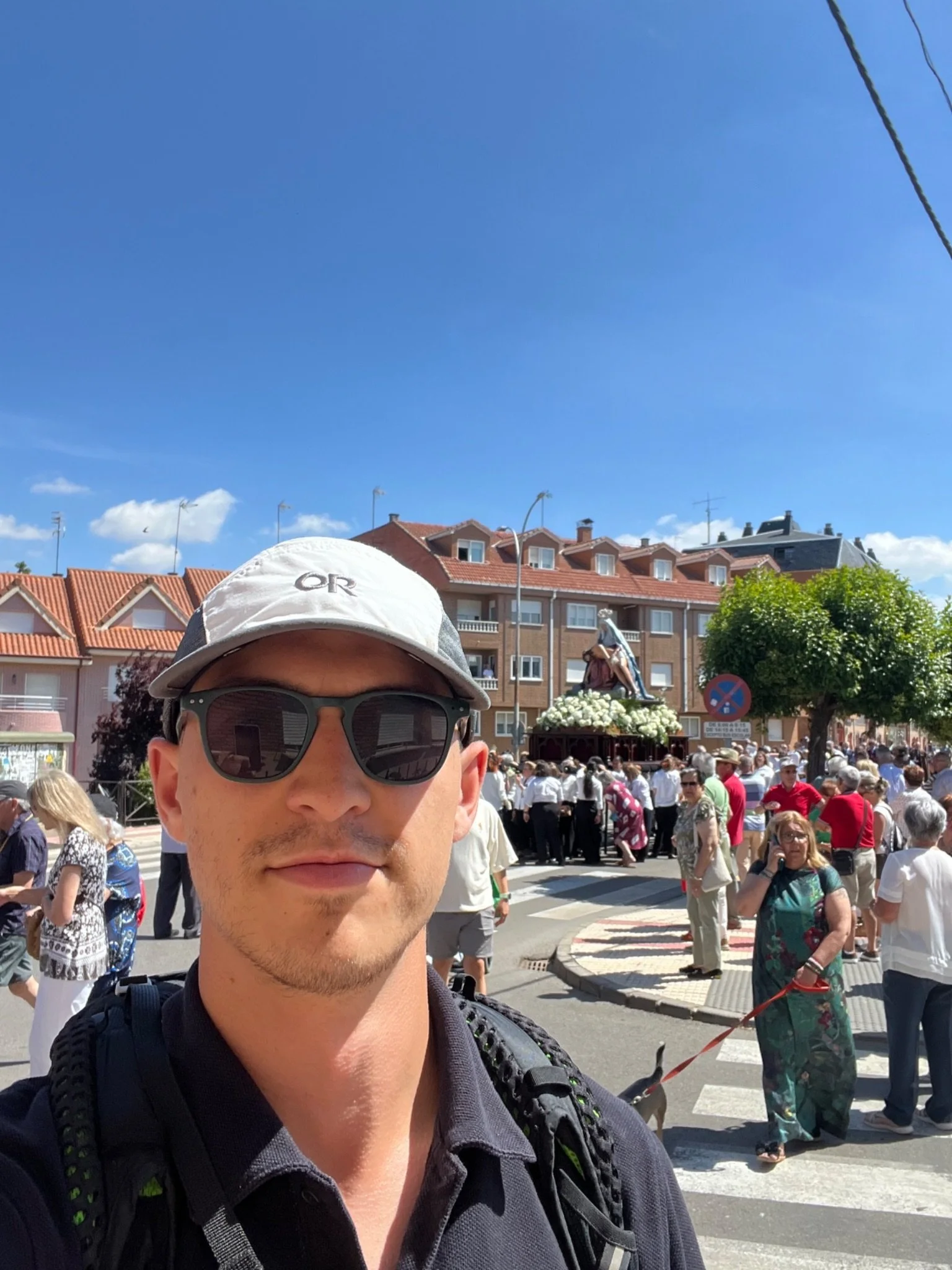
Early the next morning, I sit in a packed café over breakfast with many locals. We make a long walk to the other side of town where the procession will begin. An army of Spanish women wearing white dress shirts and black pants carry a large float with the statue of Our Lady of the Way surrounded by copious bouquets of white roses. In front of them in the procession, three teams of men carry twenty to forty foot poles with prodigious banners bearing a lamb; a host and chalice; and an inscription of the town’s motto. Two older men dressed in fine blue-and-white military uniforms bring up the rear, flanked by the mayor of the town and two other government officials.
As a band of brass and drums slowly begins to play a dirge-sounding tune, the procession starts. We walk through town and find its streets packed with residents; we sing songs of adoration and the salve many times over. When we arrive at the basilica, we are received by Fray Antonio and get his blessing.
The mass is beautiful and the large basilica is packed to the brim with generations of families. I am moved by this homegrown devotion and am able to pray for the repose of the soul of my friend’s mom—entrusting her passage to paradise into Mary’s care.
Before I leave, I follow a crowd of parishioners to the back of the church and get to touch the mantle draped around the statue of the Virgin. In the evening, I leave Virgen del Camino reluctantly and in the end, I am thankful for my delays—I needed the day of rest more than I knew and I was able to see this beautiful occasion and pray for my friend’s mom.
Nonetheless, I quicken my pace to make the next leg my journey before sundown.
7. Mary is the Mother of All
On July 16, 1251, the Blessed Virgin Mary appeared to Saint Simon Stock at a time of crisis for the Carmelite order. She gave him the brown scapular—a traditional garment for a monk—for Carmelites to wear along with a promise that anyone who devoutly wore such a garment would be guaranteed her care throughout their lives and would certainly be safeguarded from the fires of hell. This apparition of Mary bears the title of “Our Lady of Mount Carmel.”
Since then, the Carmelite order has promulgated the promises of Mary to the whole Catholic church. Any Christian can enroll in the graces of the Carmelite order by wearing a small, woolen scapular necklace as a sign of Mary’s promise to safeguard and care for them in their own lives. I’ve worn one since I was nineteen.
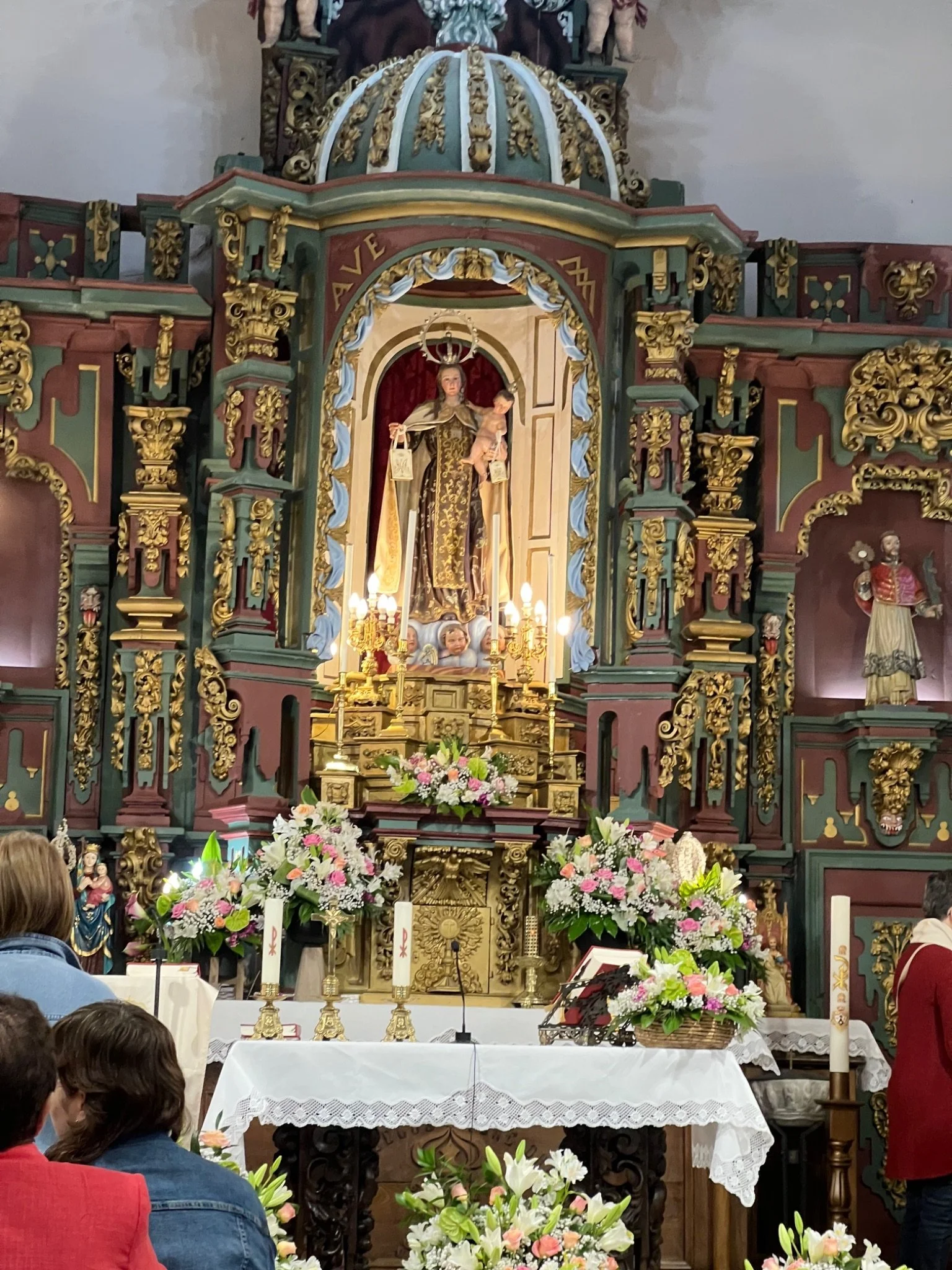
When I arrive to Ponferrada at the end of a long day of walking, I barely make it to the only evening Mass in the city: a small chapel dedicated to Our Lady of Mount Carmel at the edge of town.
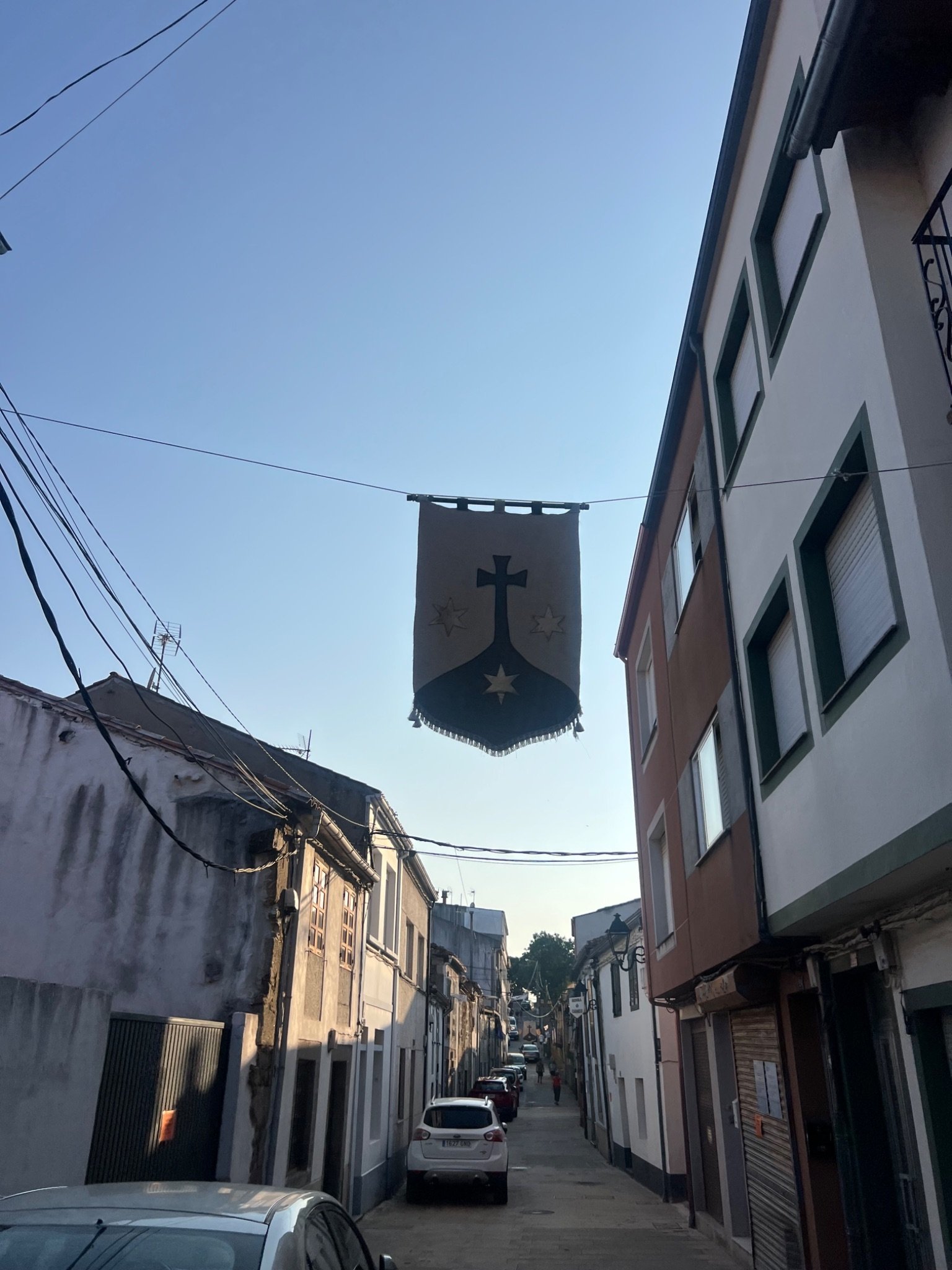
Two days later, brown and tan banners drape over the streets of Melide saying Honra ó Carmelo. Other banners bear the coat of arms of the Carmelite order. I eat the pulpo gallego commended by Sallie, Susan, and Jim and find that the only evening mass available is at another chapel at the edge of this town—the chapel for Our Lady of Mount Carmel.
In almost every church in every major Spanish town in Galicia, I find a large statue of Our Lady of Carmel. Her presence becomes constant.
So finally, on July 16, 2025, I arrive to Santiago and collapse in Cathedral square, calling my family as I rest on the cobble stones. I am awestruck to realize that today is the feast of Our Lady of Mount Carmel.
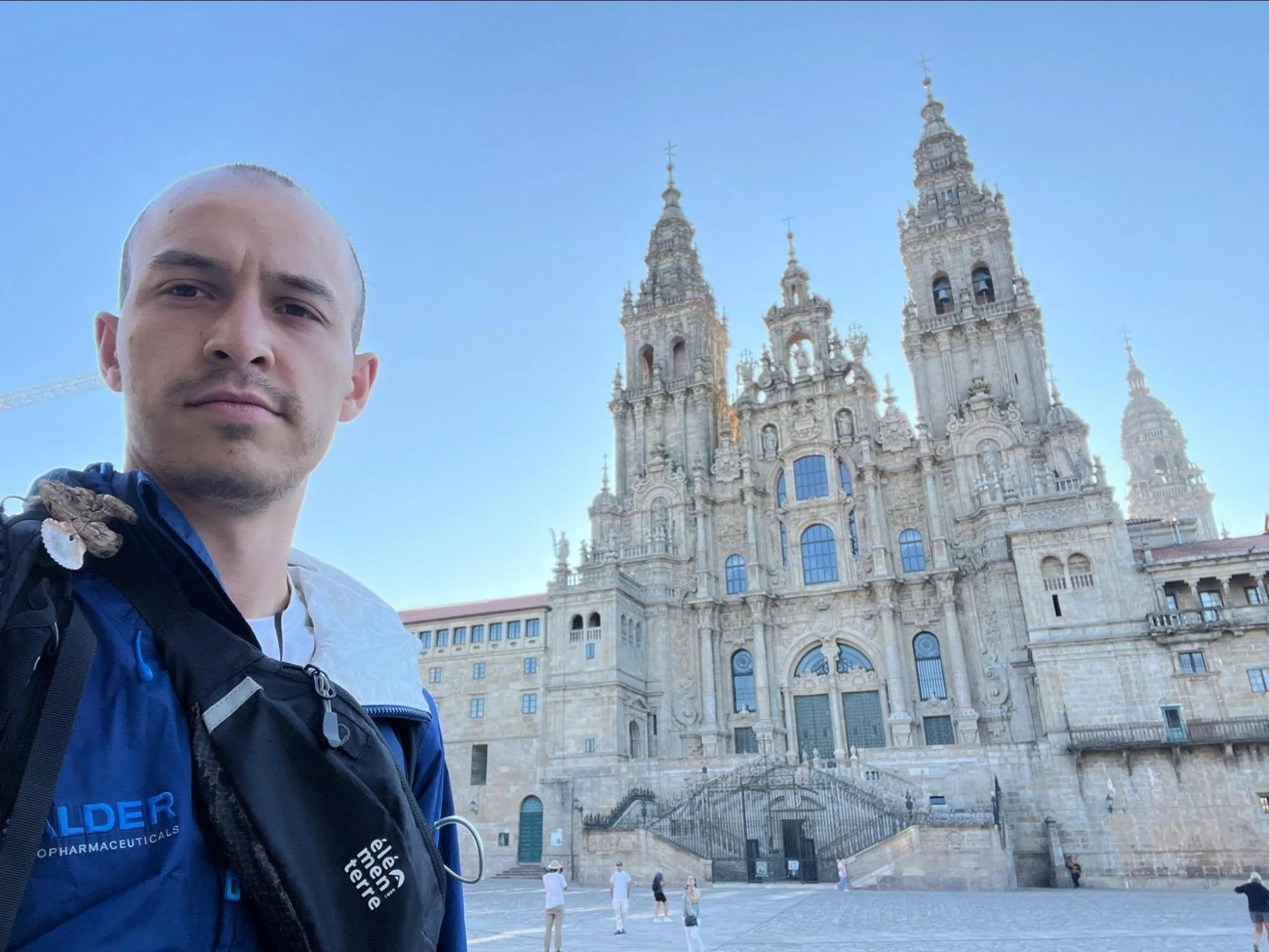
After a celebratory call with my whole family, I find the nearest café, drink three capuccinos, eat a slice of cake, and devour a big breakfast sandwich before heading into the cathedral of Saint James the Apostle.
The Canon of the cathedral celebrates mass for the feast and preaches a homily about Mary’s intercession as a sign of hope for all Christians. A nun leads us with an immaculate voice in the hymn for Our Lady of Mount Carmel. I’m amazed at the botafumeiro—a giant thurible flying through the cathedral transepts—pouring out incense on sweaty pilgrims.
After mass I pray with the relics of the Pilgrim Apostle and ask his intercession over Padre Jesús, my life, and all the people God has entrusted to me, especially for my work at Stanford this year. When I leave the Cathedral and pick up my compostela, I feel my journey is over and I am thrust back into the real world.
By the end of my Camino, the two shoulder straps of my green Osprey pack have become a familiar yoke. Hanging off its many straps and hooks are a neon-orange ribbon, a large white shell, a piece of driftwood, and yesterday’s drying laundry. Every item in this pack weighs down on me—down to the extra pair of socks that I switch out each day. After so many miles, the bouncing of this second-hand bag with each of my steps gives an occasional dagger-like pain in my mid-back. My pack serves as a clear and loud symbol to every Spaniard that I am a pilgrim and, for me, is a small experience of poverty while I walk the Camino.
After my pilgrimage ends, though, my brown scapular becomes a new woolen yoke of pilgrimage that I will bear long after my Camino is over. Unlike my pack, this yoke is quiet, humble and simple. It is light and subtle—so subtle I forget about it from time to time. And yet it is a constant prayer, a powerful reminder of Mary’s presence in my life and her constant intercession for me and for all Christians to grow closer to her son, Jesus.
Conclusion
After Jesus washes the feet of his disciples, He asks them “do you know what I have done to you?” (Jn 13:12). I’ve always been struck by the thought that Jesus hasn’t just done a nice thing for His friends, He’s done something to them. He’s loved His disciples in a way that will change them forever.
As I think of those who have loved me in this way, I think of my father and mother, my brothers and sister, and a small number of friends. But after the Camino, I also think of all the unexpected people, places, and circumstances God has used in my life to love me in a transformative way. Now I understand that the Camino was a lesson and challenge for me to see how He transformatively loves me through the people, places, and circumstances I encounter every day.
At the end of my own life, I wonder how many will say that it was my love that God used to change their lives. That God, using me, helped them know the Love of Christ.