Alex Soto
Sanctification Abroad
Winter quarter at Stanford was brutal. Despite trying my hardest, I barely scraped by to finish my electrical engineering assignments each week, lacking the joy of learning and even the satisfaction of receiving good grades. When my GPA dropped, it stung. I always had confidence that I could ace any class if I worked hard enough, so it unsettled me to learn that some things could be beyond my capabilities. At the same time, I experienced hardships in my personal life, which left me disoriented and in pain. My identity as a good student was being challenged, and my heart was being broken open.
All of this unfolded at the beginning of Lent, which gave me consolation: I felt God’s proximity, and I could hear Him telling me that I was exactly where He wanted me to be. But I also felt frustrated. I couldn’t understand why God would use suffering as a means of achieving his will. I couldn’t understand why He had abruptly stripped me of the joy and sense of control that He had given me. I trusted that God was working in my best interest, but I was also impatient to know the exact details of His plan and receive reassurance that He would put me back together.
Just before my study abroad experience in Florence, I was spiritually and emotionally unsteady. It frustrated me that I wouldn’t embark on this journey with a steady heart. Yet, despite my unease, I sensed that God was asking me to lean in on my uncertainties and draw nearer to Him. With no choice but to trust, I surrendered the entire experience to God, asking Him to make of it, and of me, whatever He willed. Much later, I realized that God answered my prayer through three encounters that mirrored the mysteries of the rosary—marked by joy, sorrow, and glory—each one a small step toward my sainthood.
A Joyful Experience:
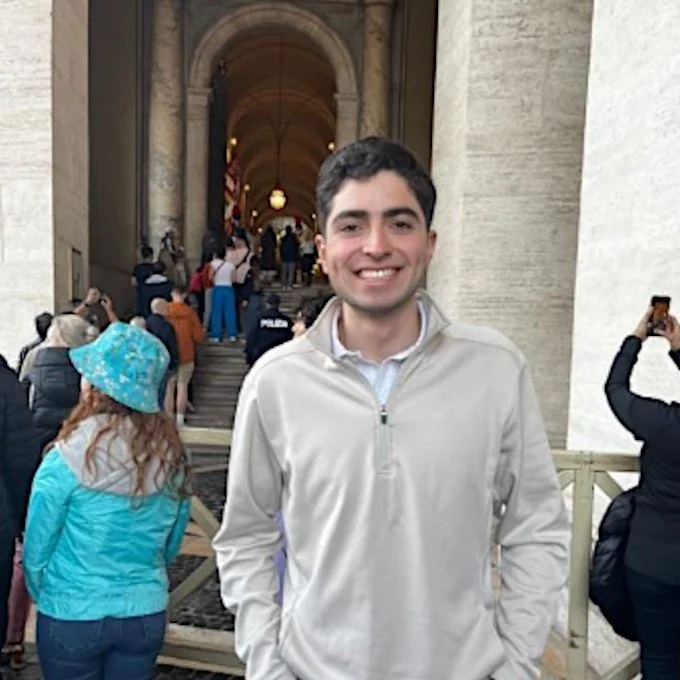
On Easter dawn, my friends and I are among the first to arrive at the gates of the Vatican. Though, it doesn’t take long for the street to become completely flooded by tourists. The air is still, and the sky is black. My friends and I stand in the darkness. Even though I’ve just met these friends a few weeks prior, we’ve already grown close. We frequently have deep conversations about our faith and personal lives, and I already feel confident that I can trust them with anything. While we wait for the gates to open, I’m grateful that I will experience this Mass with them. In this moment, I not only feel connected with my friends but also with everyone surrounding us. I’m struck to see so many different faces and hear different languages. Everyone here has a life story, and for this brief time, all our stories converge as we await the joy of Christ’s resurrection.
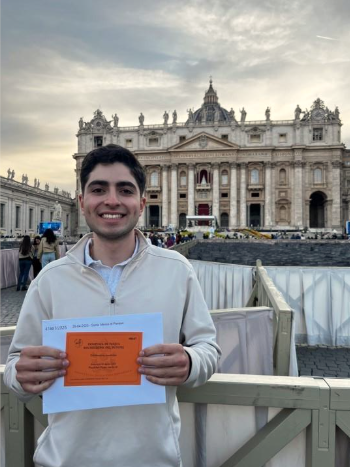
Just as the sun rises, the gates of the Vatican open. We sit in St. Peter’s square until the sound of trumpets and drums causes the entire audience to stand and turn back. The Swiss Guard Band signals the commencement of the Easter Mass. Beaming with anticipation, I stand as tall as I can to get a glimpse of what is happening. The yelling from the crowd makes me turn my head in all directions. When the Mass celebrant, a frail man dressed in white, comes out to the Square, my heart races. “Is that Pope Francis?” I’m immediately starstruck. I can’t believe that I’m in the presence of the Pope. As I give thanks to God for the wonderful blessing, a zoomed in shot of him appears on a big screen. It’s not Pope Francis.
The homily, prepared by the Pope and delivered by Cardinal Angelo Comastri, carries a simple message: our hearts long for the infinite but stop short at the things of this world. Despite being completely in Italian, the words penetrate deeply into my heart. I’ve been in mourning for the past few weeks. But in that moment, I feel God reframe my pain. My ache for what I’ve lost is really an ache for Him. It consoles me to know that true fulfillment is possible, and it will come in eternal union with God.
At the conclusion of Mass, we receive the surprise that Pope Francis will step out to give the audience a blessing. For about thirty minutes, every eye and phone is locked on the balcony. Each subtle movement of the curtain causes a commotion in the crowd and a restlessness in my chest. My body is tense with anticipation. Part of me doesn’t want the Pope to appear too soon because I don’t want the moment to end. When the curtains are finally drawn back, all I can make out is a small white figure, waving at the crowd. As I wave back at him, I feel a soft joy, the same kind a child feels when he sees his father. When given the microphone, Pope Francis manages to say, “Dear brothers and sisters, happy Easter!” It’s only six words, but it’s clear to me that they contain every bit of his energy. I sense the deep love Pope Francis has for the world. As I and the rest of the Papal audience receive his blessing, I feel a deep gratitude for the Pope and for the love God is sending through him.
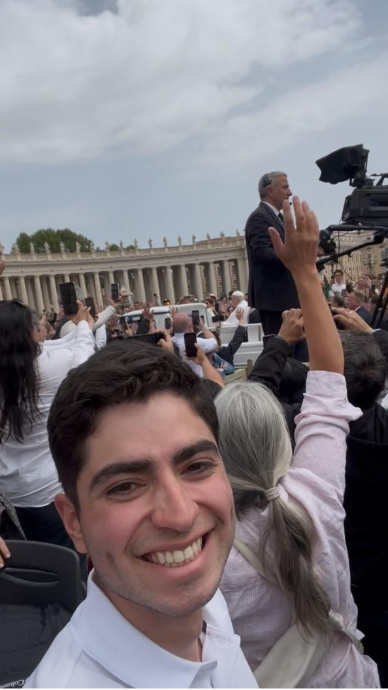
Shortly after, the big screens announce that the Pope will be riding through the square on his popemobile. People storm to the barricades. It must be thirty minutes of waiting before loud screams in the distance make me stand. I quickly look up toward a big screen to see the back of the Pope’s head and people cheering in the periphery. My smile grows bigger with every child he blesses. As the Pope makes his way toward us, I have a decision to make: will I film or savor the present moment? When he is about thirty feet away from me, I snag a quick selfie. I then quickly put away my phone to watch him drive off. His exhaustion is apparent, so I feel honored that he greeted us so closely. Once I no longer have direct sight of him, I whisper, “I’ll see you again next week for the canonization of Carlo Acutis.”
Experiencing Easter Mass at the Vatican and seeing Pope Francis were great joys that God granted me. God lifted my spirit at a time when I needed it. But more than that, He gave me a small taste of the ultimate fulfillment that is obtained in Heaven.
A Sorrowful Experience:
The morning after Easter, I wake up with a feeling of heaviness in my chest. I’m exhausted from a late night of touring Rome, but I can’t fall back asleep. My friends are already up, getting ready to visit St. Peter’s Basilica. I planned to sleep in that morning but decide to join my friends, hoping that the walk and fresh air will shake off my anxiety.
Upon entering the Basilica, I’m amazed by the sheer magnitude of everything: the arcades, the side chapels, the main altar. I slowly walk around, saying a short prayer at every devotional chapel and admiring every work of art. I also adore the Blessed Sacrament, receive confession, and walk through the Holy Doors. It confounds me how I could be surrounded by such holy beauty and still carry so much unease within me. My faith isn’t taking away my cross, but it gives me something to cling onto while carrying it.
Shortly after leaving St. Peter’s Basilica, my phone buzzes. My friends notice by my expression that something is wrong. I turn my phone toward them. “Pope Francis has died at the age of 88.” I stare at my phone for a while at a complete loss of words. “I just saw him yesterday! How can he be dead?”
It seems to me that the Pope’s death is providential. It’s fitting that he gave the entire world his final blessing on Easter and returned to the Father the next day. Despite my initial shock, I feel greatly honored to have witnessed such a historic moment.
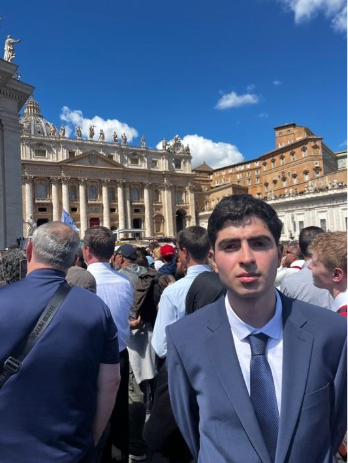
After a quick brunch, my friends and I return to the Vatican to find the entrance flooded with tourists, eager to see what’s happening. In just an hour, the celebratory atmosphere from Easter has become heavy with mourning. A somber bell rings loudly for every year of the Pope’s life, while workers toss the Easter floral arrangements into the beds of small trucks. It’s hard for me to process the sadness because it came to me after a spike in joy. That afternoon, we return to Florence, only this time without a Holy Father.
Later, I learn that Carlo Acutis’ canonization, which was scheduled for the following weekend, will be postponed for the funeral. To say I am disappointed is an understatement. Of all the moments I hoped to experience abroad, Carlo’s canonization was the one I anticipated the most. In the months prior to my trip, I had grown a deep devotion to Carlo because his simple faith and modern life resembled mine. I considered it providential that I would be in Italy at the time of his canonization. But now, it seems like this grace was taken away from me too.
Since my train tickets are already booked for the upcoming weekend, I decide to adjust my plans to attend Pope Francis’s funeral. I return to Rome the second time with mixed feelings, excited to witness another historic moment but also saddened to be there for the Pope’s passing. The early morning of the funeral, I arrive at Vatican City to find a horde of tourists waiting by a gate. I quietly stand with them. There are many young people present for the Jubilee of Teenagers. Many proudly wave Carlo Acutis flags, and it comforts me to know that I’m not the only youth mourning the loss of the canonization.
As we move little by little, the crowd of tourists gradually makes its way across Via della Conciliazione, the long street leading up to St. Peter’s Square. I keep looking back, marveling at the sea of people pressed shoulder to shoulder. More than that, I’m struck by the fact that the entire world is watching from home. It’s satisfying to be a small part of something big. As we walk, the Sun breaks through a small hole in the clouds, casting a light on all those mourning the loss of the Pope. I take it as a gentle sign that God is with us in our sorrow.
Pope Francis’ funeral Mass begins with a procession of global and religious leaders, each stepping forward to pay their respects. I’m inspired by how Pope Francis’ life, marked by humility, has drawn people from every corner of the world to mourn him together. The Mass is beautiful. I have a clear view of the coffin and watch with reverence as the Rite of Commendation and Farewell take place. A part of me feels out of place at the funeral. “What do I have to offer a man who did so much good for the world?” But eventually, I am satisfied in simply offering my quiet, reverent presence. As he is taken away in his coffin, I say my farewell, feeling a sense of peace at having been able to pay my respects.
The loss of Pope Francis came abruptly, yet I came to see it as another grace God had granted me. Through it, I learned to enter sorrow not with resistance but with a peaceful and humble surrender. It is in sorrow that we draw nearer to Christ, who endured the ultimate suffering.
A Glorious Experience:
In my final days in Italy, I have only one regret: I haven’t made a pilgrimage in honor of Carlo Acutis. Attending Carlo’s canonization was what I looked forward to most during my time abroad, so it feels wrong to leave Italy without visiting his tomb in Assisi. During finals week, I find one free day, and I’m determined to make a pilgrimage out of it. This time, I want to go alone. Every other trip I have taken was at the suggestion of my friends. But I want my visit to Carlo to come from my own will and be offered for my own spiritual growth.
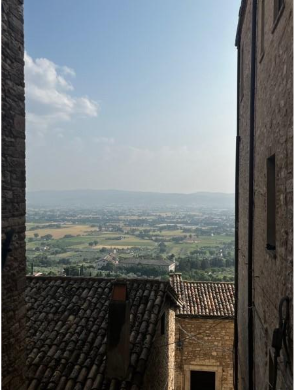
I get off the train with urgency. I only have four hours to visit St. Francis, St. Clare, and most importantly, Carlo Acutis. Yet beyond the pressure of time, I also feel compelled to make this pilgrimage meaningful, seeing it as the culmination of my time in Italy. I immediately search for the directions to the Church of Santa Maria Maggiore, where Carlo’s tomb is located. To my shock, I learn that it’s an hour walk from the train station. My heart sinks slightly, but I also feel a spiritual thrill, as if my pilgrimage will mean more if I must work harder for it. When I look in the direction of the church, I see in the distance a beautiful city on top of a hill. It is as if God is encouraging me by revealing my destination. Though I’m unsure what the journey will look like, I take out my rosary and start walking toward the city on the hill.
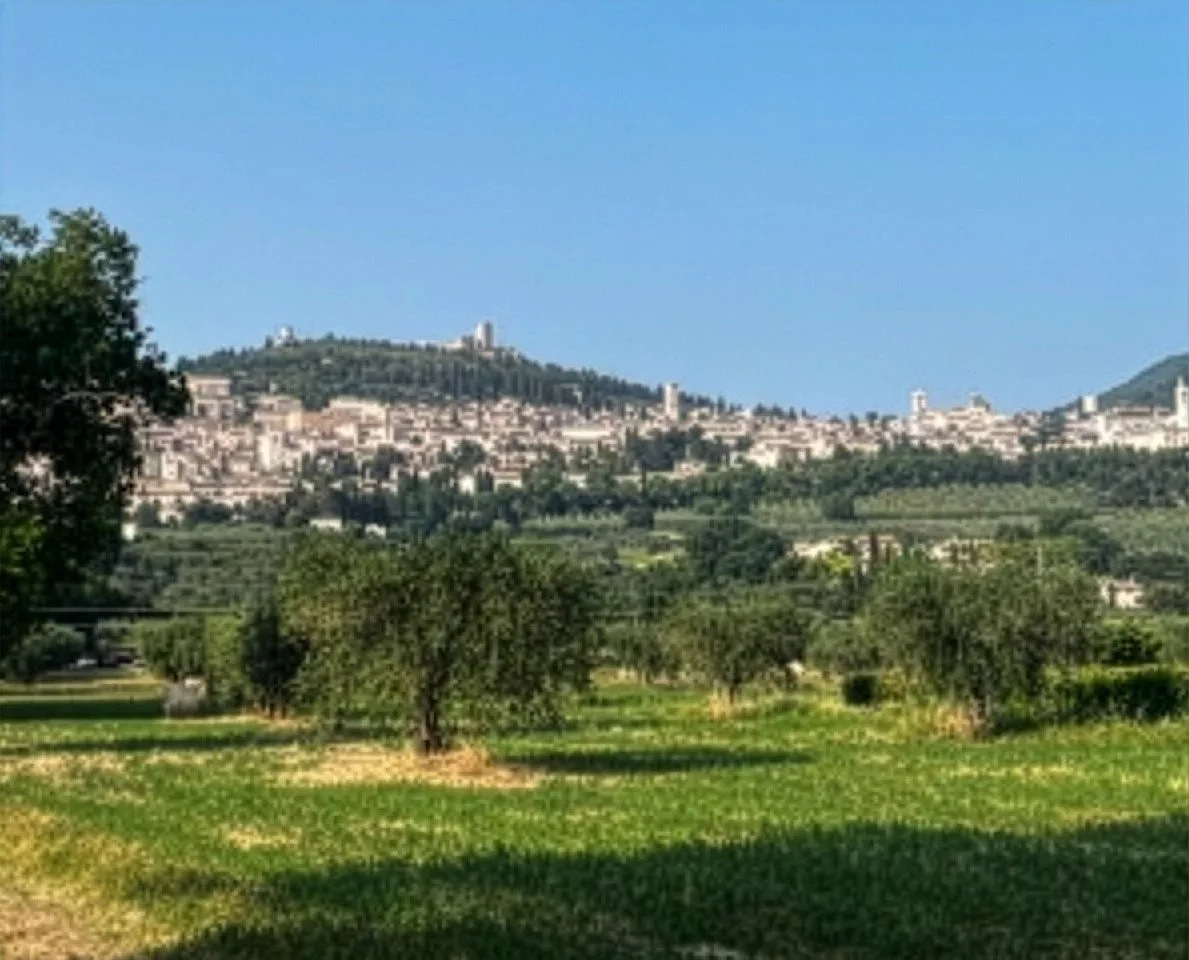
As I hike to Assisi, a disturbing thought crosses my mind: “I’m walking alone in the middle of nowhere and am completely cut off from everyone I know.” But the holiness of Assisi seems to surround me, filling me with an unexpected sense of peace and safety. I trust that if I need any help, the people of Assisi will take me in. I begin to recite the rosary, which gives me a comforting assurance that Jesus and Mary are shielding me from harm. As I admire the green fields and distant mountains, I wonder if St. Francis had ever walked this same path. Surrounded by such beauty, I begin to understand how he could be so humble and loving toward God’s creation. In the quietness of my hike, it feels natural to fall into awe of the world around me.
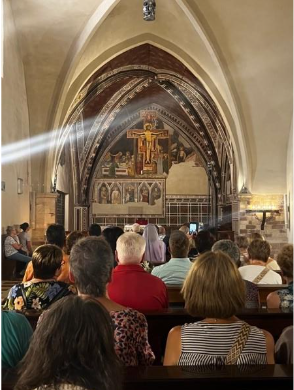
I first visit the Basilica of St. Clare. After entering a small side chapel, I notice many pilgrims kneeling in quiet reverence before a large painted, wooden crucifix. I don’t know the significance of the cross, but I know I’ve stumbled upon something sacred by seeing the reverence in which people pray. It is the Cross of San Damiano, the cross that spoke to St. Francis and gave him his vocation of rebuilding the Church. As I pray before the cross, I try not to pray too fervently out of a slight fear that the cross might start speaking to me. Still, a part of me longs to receive some of the clarity St. Francis received, to know exactly what God is asking of me. Afterwards, I make my way down to the crypt to visit St. Clare. I know that she had drawn deep inspiration from St. Francis. Though I don’t know much else about her, I pray before her tomb, trusting that she already knows me well and will gladly intercede for me.
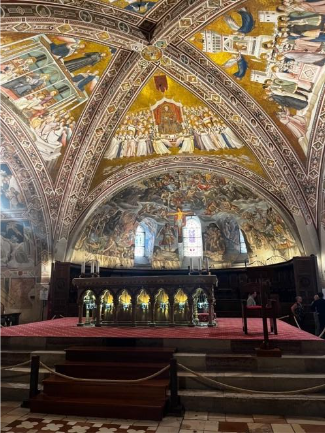
In the Basilica of St. Francis, I’m warmly greeted by Franciscan friars. The interior of the church is vibrant: the walls adorned with the most colorful frescoes and the main altar beautifully lit by hanging blue lanterns. Surrounded by so much color, I’m quietly captivated by everything and slowly take it all in. The crypt of the church, by contrast, is plain and unadorned. I feel a great honor kneeling before the tomb of a saint who transformed the Church. St. Francis’ radical detachment from wealth moves me to reorder my priorities, to place my desire for heaven greatly above my desire for material things. In front of his tomb, I quietly ask for his intercession, that I may also grow in the virtues of poverty and humility to the extent that God wills.
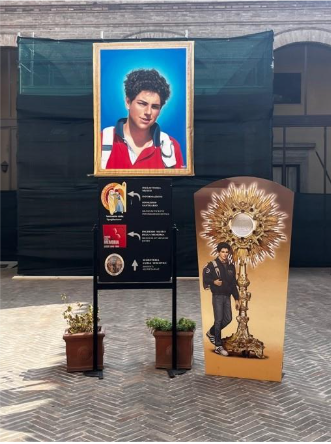
Walking into the Church of Santa Maria Maggiore, I see, in the most unsuspecting corner, the tomb of Carlo Acutis. I’m hesitant to get close. The kid who I’ve come to know through stories and prayer is now ten feet away from me. I am frozen in place, yet I can’t take my eyes off him. “You can come closer,” the gentle voice of a woman working in the church urges me. Prompted forward, I take a seat in front of the tomb, now very close to my good friend. He’s tall. And he looks alive as if he’s just peacefully sleeping. I try to speak to him, but I have no words to say, so I simply hang out in his presence. As I look at Carlo, all I can think about is how similar he is to me. He’s wearing jeans and Nikes. He had a passion for technology. He prayed the rosary and had a deep devotion to the Eucharist. Gosh, he even looks like me! In this moment, God’s voice is resoundingly clear: “Alex, what I have done for Carlo is what I want to do for you.” It’s like a soft promise. God isn’t asking me to do the impossible. He’s showing me what He will do for me, if I allow it. Before I leave, I touch Carlo’s tomb. Like a goodbye. Like I’ll see him again.
Walking out of the church, I’ve received a clear mission: to become a saint. I have hope in knowing that the same God that worked in St. Clare, St. Francis, and Carlo is working in me too. I feel ready to embark on the journey to sainthood. I don’t know exactly what God is asking of me, but I know what His end goal for me is. I trust that He, and my friends in Heaven, will help me get there.
A Final Reflection:
St. Carlo Acutis once said, “The Rosary is the shortest ladder to Heaven.” After my time abroad, I came to understand this in a new way. The rosary is more than a series of prayers and meditations; it is a journey that is lived out alongside Jesus and Mary. The joyful mysteries give us a small taste of Heaven, and the sorrowful mysteries draw us closer to Christ. While joy and sorrow can overwhelm us, they serve to mold our hearts in preparation for the resurrection that awaits us in the glorious mysteries. It is in embracing these mysteries and walking alongside Jesus and Mary that we become saints.
I have surrendered my study abroad experience to God, and He transformed it into my sanctification abroad. Amid the joyful, sorrowful, and glorious experiences I was blessed with, Jesus and Mary were continually holding my hands and shaping my heart. Although the road to sainthood is a lifelong journey, I take refuge in knowing that God and the saints will be walking with me. I can only hope that one day, I’ll be eternally united with God, with the saints, and with you in Heaven.