Br. Antonio María Aguilar, O.P.
Four times did I wrestle with the question of becoming a priest.
The first time, I wasn’t yet at Stanford. I had just been admitted. I was still in Costa Rica, where I was born and raised. I had become a Catholic about five years prior because two kids at my high school, three years my senior, became models for me. They were joyful, great friends to one another, and hilarious, but also respectful. I followed them into an ecclesial movement. Should I follow the path of the priests in this group? One of the men brought up the point with me directly. That idea didn’t sit well with me. I had a golden ticket to Stanford in my hand. I had always wanted to attend college in the United States. So I told God, “Later. I need to go study.” And He said, “Yes.”
The second time was around my junior Spring at Stanford. I had chosen to major in Symbolic Systems, which was an excellent fit for me. However, I was having an identity crisis while taking classes for my Artificial Intelligence concentration. I quickly realized that I did not actually want to work as a Machine Learning Engineer. What should I do instead? I could become a Dominican, like the chaplains of the Catholic Community at Stanford. I yearned for a deeper intellectual life, lived out in community and then shared; I cared deeply about the liturgy and wanted to provide the saving graces of the Catholic faith to others. But again, I felt that the answer to this question was “No,” or at least, “Not yet.” I was struggling through my AI classes due to several faults of my own: distraction, emotional avoidance, and delay. I didn’t want my departure from the world to feel like an escape when things weren’t going my way. I figured graduation and a change of setting were what I needed. So I told God, “Later. I need to go work.” And He said, “Yes.”
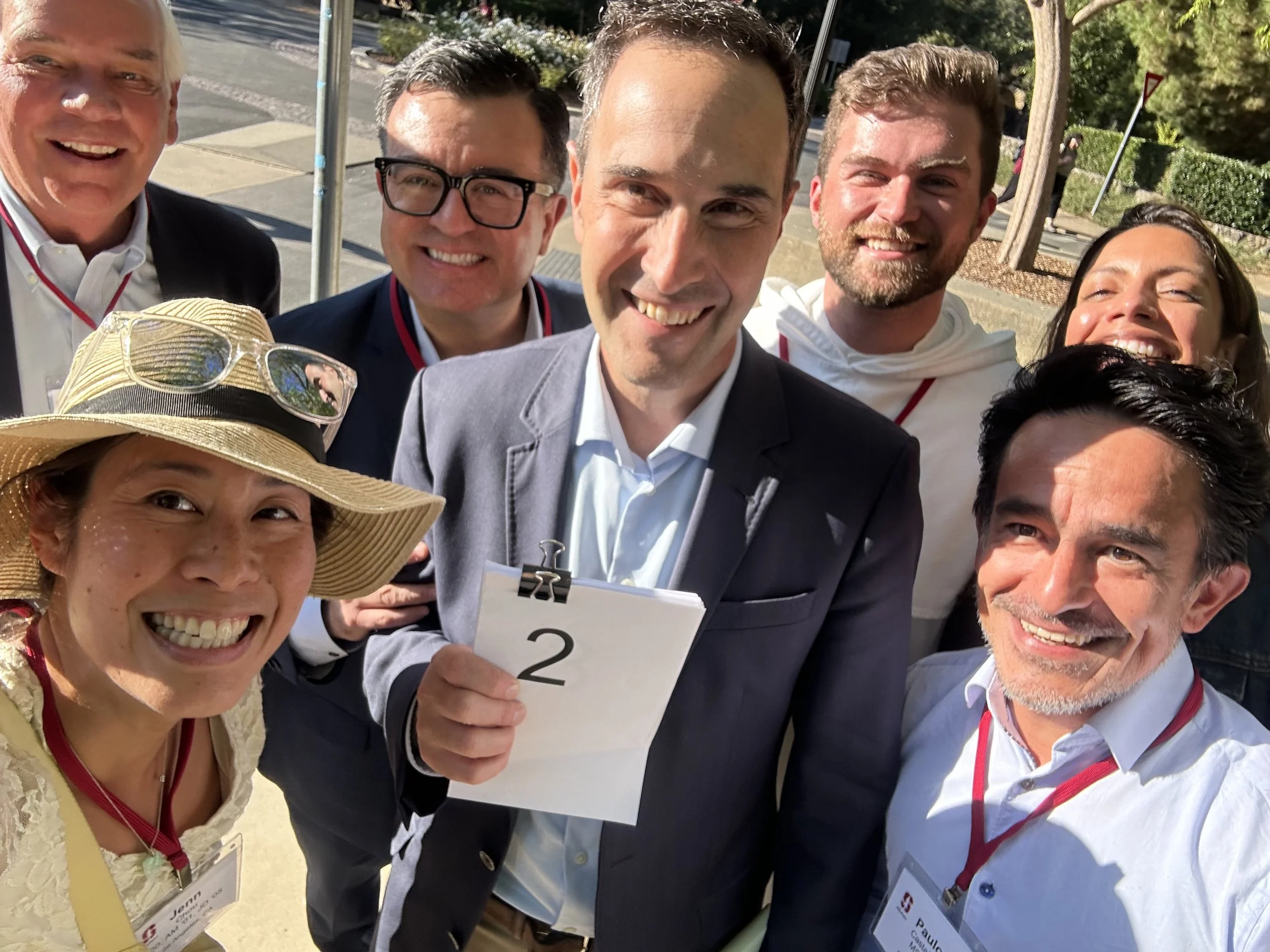
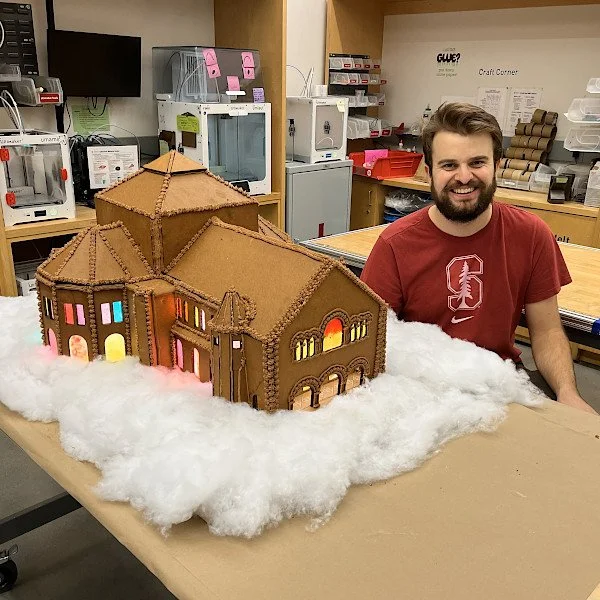
I served on the Stanford Alumni Association Board of Directors. For my fifth and last year, I went as a Dominican brother. Here’s a photo of my team on our beginning-of-year scavenger hunt. The alum we took a picture with was none other than Pres. Levin.
The third time, I was two years into a good job in the tech industry. I had found a role that utilized my fluency with technology but also leveraged my interpersonal skills. I was improving my time management skills, learning a lot on the job, and thriving both at work and socially. The circumstances that had made me ask God to wait were gone, so I contacted the Vocations Director for the Western Dominican Province. I visited the Priory in Oakland. As I experienced how the student brothers live, I realized that there was something else on my heart. I really wanted to experience being in a serious romantic relationship. So I told God, “Later. I want to go date.” And He said, “Yes.”
The fourth time came not long after I finally experienced healing from a particularly tough breakup. The relationship had lasted about ten months, but it was serious enough that we talked about engagement. I had never had my heart broken before, but I had some sense of what counted as a “reasonable” level of pain—and I was fairly sure I was beyond it. So I sought help through therapy and spiritual direction and dared to ask, “Why did this hurt so much?”
It became clear to me that I had many distinct desires riding on the success of this one relationship—most of which I was unaware of. Some of these, viewed individually, were easily identified as thin desires. These didn’t really drive me. For instance, there was a desire to be seen by others as someone who had figured out his life early. Others were thick desires with roots deep in my heart. One of these was the desire not only to be generous with the things I own, but to be myself a gift, given in vulnerability and gratefully received.
I came to understand that God not only tolerates but even delights in these core desires of our hearts. Who but Him put them there? However, He may not fulfill them in the way we might expect. In my case, this meant loosening my grip on marriage and a natural family as the only possible way to secure my happiness. I had seen the priesthood and religious life as something that God might want me to do, but that I had to resist if I wanted to be truly fulfilled. Recognizing that these deep desires were compatible with a celibate life altered my perspective.
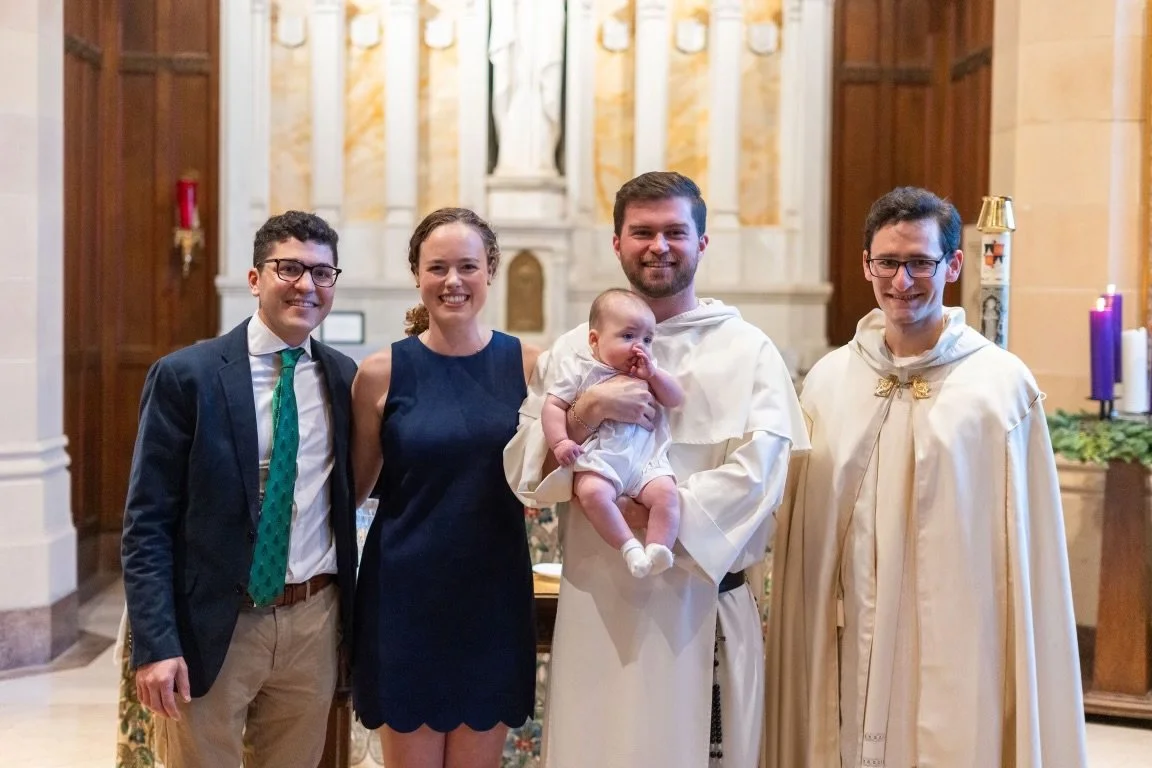
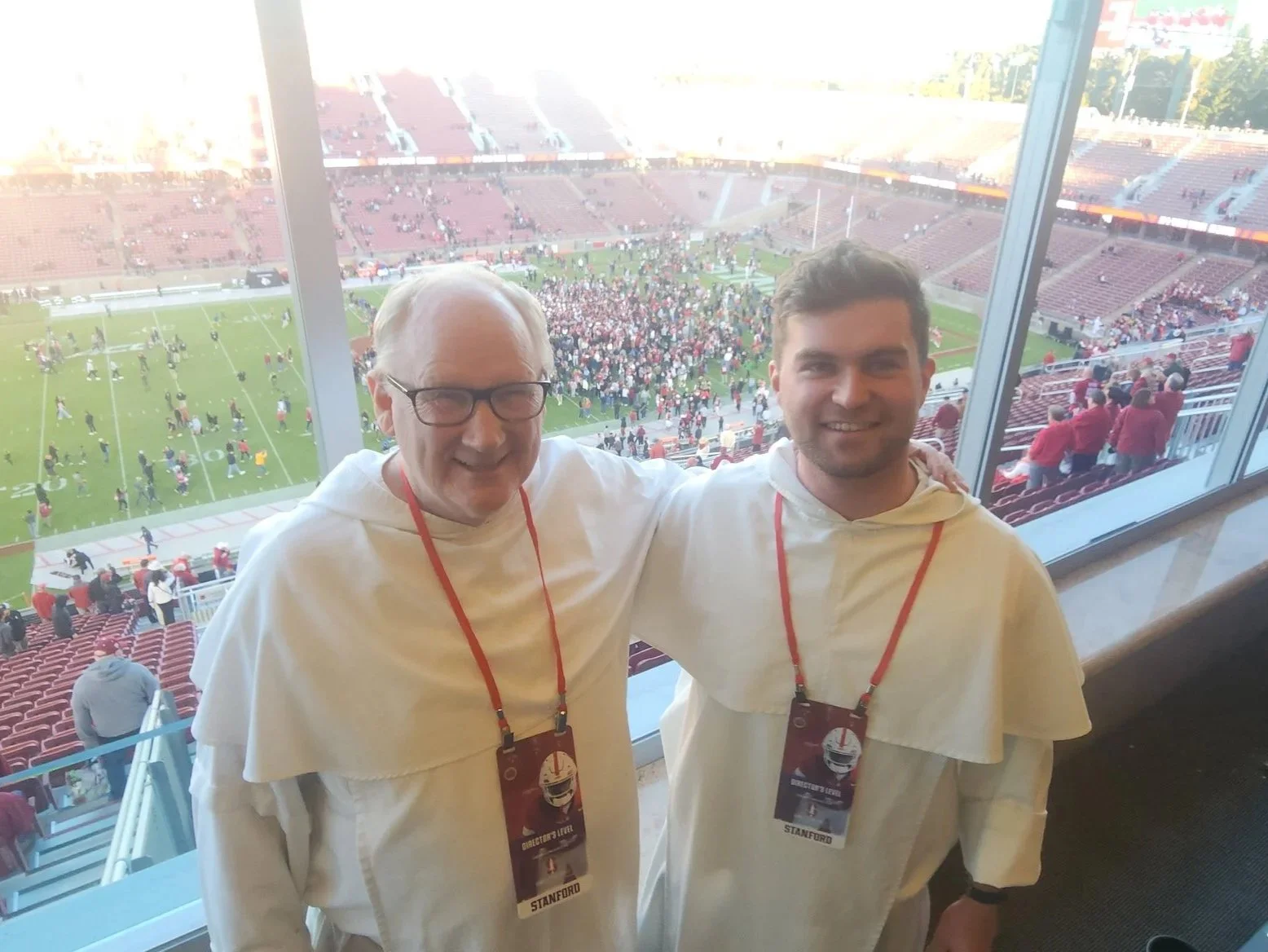
In this photo, I’m with my friends John Szot, Kelsey (Schroeder) Szot (’17, from the Catholic Community), their son Deaken, and Fr. Patrick Rooney, O.P., who had just celebrated Deaken’s baptism.
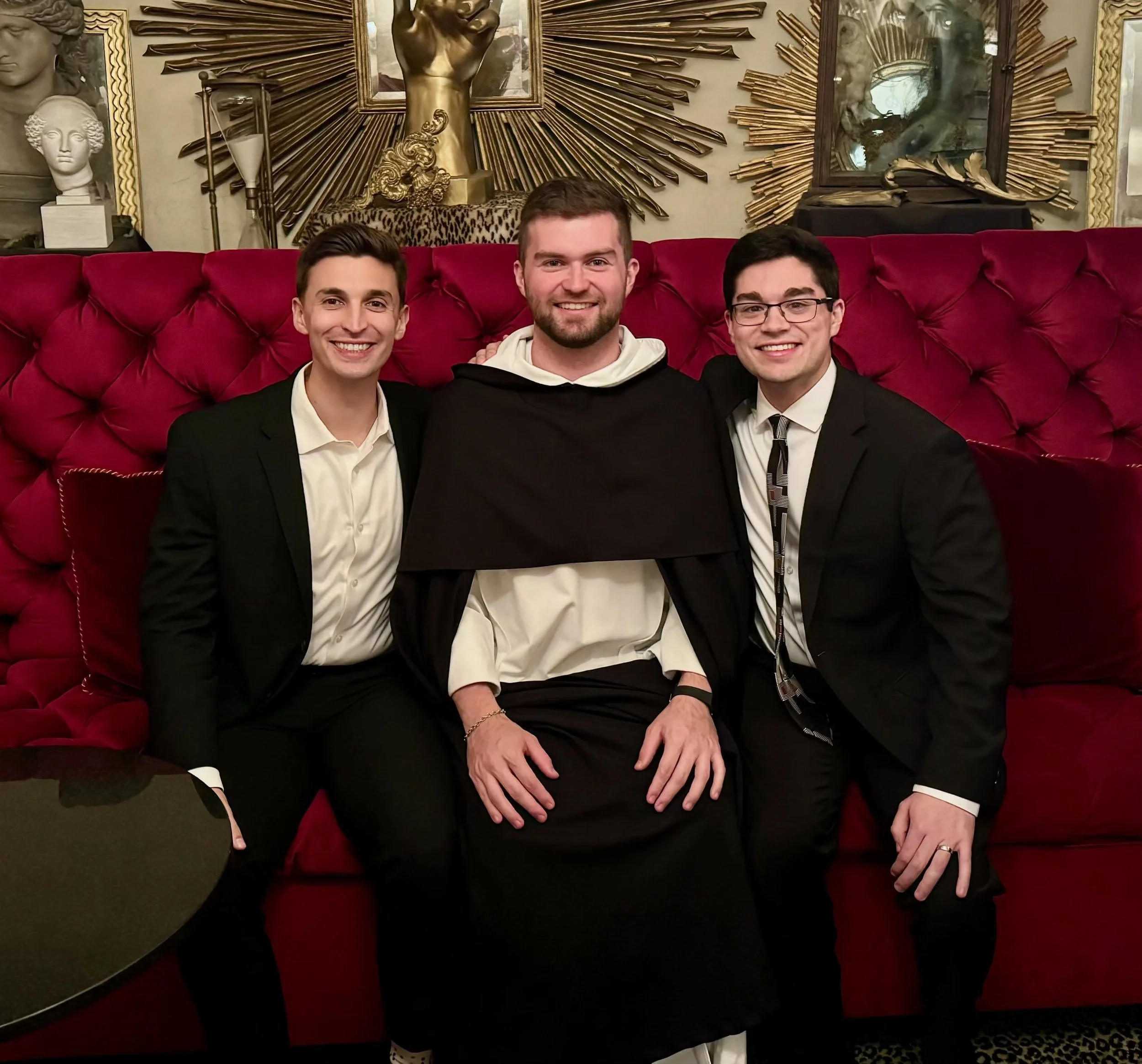
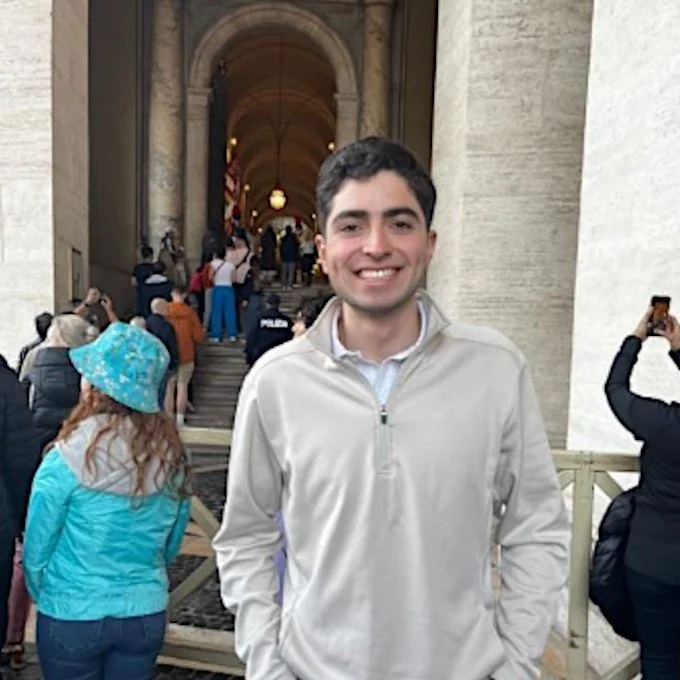
Here I am with Sam Weyen (’18) and Ben Barnett (’19), friends from Sigma Phi Epsilon. This was at Steven Howell’s wedding!
I contacted the Dominican Vocations Director again. I went back to Oakland for a second visit and then for interviews. The next step would be a battery of tests and a formal application. But a part of myself was extremely reticent. “What if I’m wrong, and I’m headed towards a life of cold, unfeeling loneliness? Shouldn’t I maybe wait another year to make sure this is all settled?” I told God, “Later.” And He said, “No.”
“No?” “No,” continued the Lord, “if you make me wait another year, I just might call someone else.” Like all the words I’ve mentioned, I did not hear this audibly, but only silently in my heart. It wasn’t what I expected to hear from God, who had been nothing but patient with me for more than a decade. What surprised me the most was my immediate response: “Lord, I don’t want You to call someone else.” As I spoke those words, I knew that I wanted to follow Christ in His call, despite my fears.
God’s “No” made more sense the more I thought of it. Every chapter of my story that began with me telling God, “Later,” and hearing His affirmation in return, had prepared me to respond right then and there.
During my time at Stanford, I expanded my intellectual toolbox by studying under mathematicians, computer scientists, linguists, psychologists, product designers, and even philosophers. I learned how each of them breaks down and approaches problems; I still benefit from these different ways of thinking. Even so, I found myself wanting to focus on the sacred sciences: theology, first and foremost, and philosophy understood in a more classical sense than is typical in the contemporary secular academy. I knew I needed a community to help me grow toward that knowledge.
At work, I became a more dependable team member. I learned how a startup—and by extension, a business—runs well. I’ll never forget those lessons, and I expect to have many opportunities to apply them in the future. However, I wanted to serve primarily in a way that wouldn’t scale in the way startups are expected to. I wasn’t excited about building a product. Instead, I found myself wanting to do priestly things, on a human scale: hearing confessions, providing counsel and direction, saying Mass, and preaching to a congregation.
Lastly, through heartbreak, I came to realize that God knew me better than I did. He revealed my heart to me and, in doing so, won my trust. I could no longer doubt that God wanted me to be happy. At the same time, I couldn’t deny that my heart yearned for vows—for the experience of genuine self-gift. That desire didn’t just draw me toward priestly ministry; it also pointed me towards religious life. I began to see that God was inviting me not only to serve His people as a priest, but to belong to Him in a more total, consecrated way—in a community, with vows, as a brother whose whole life is set apart for God.
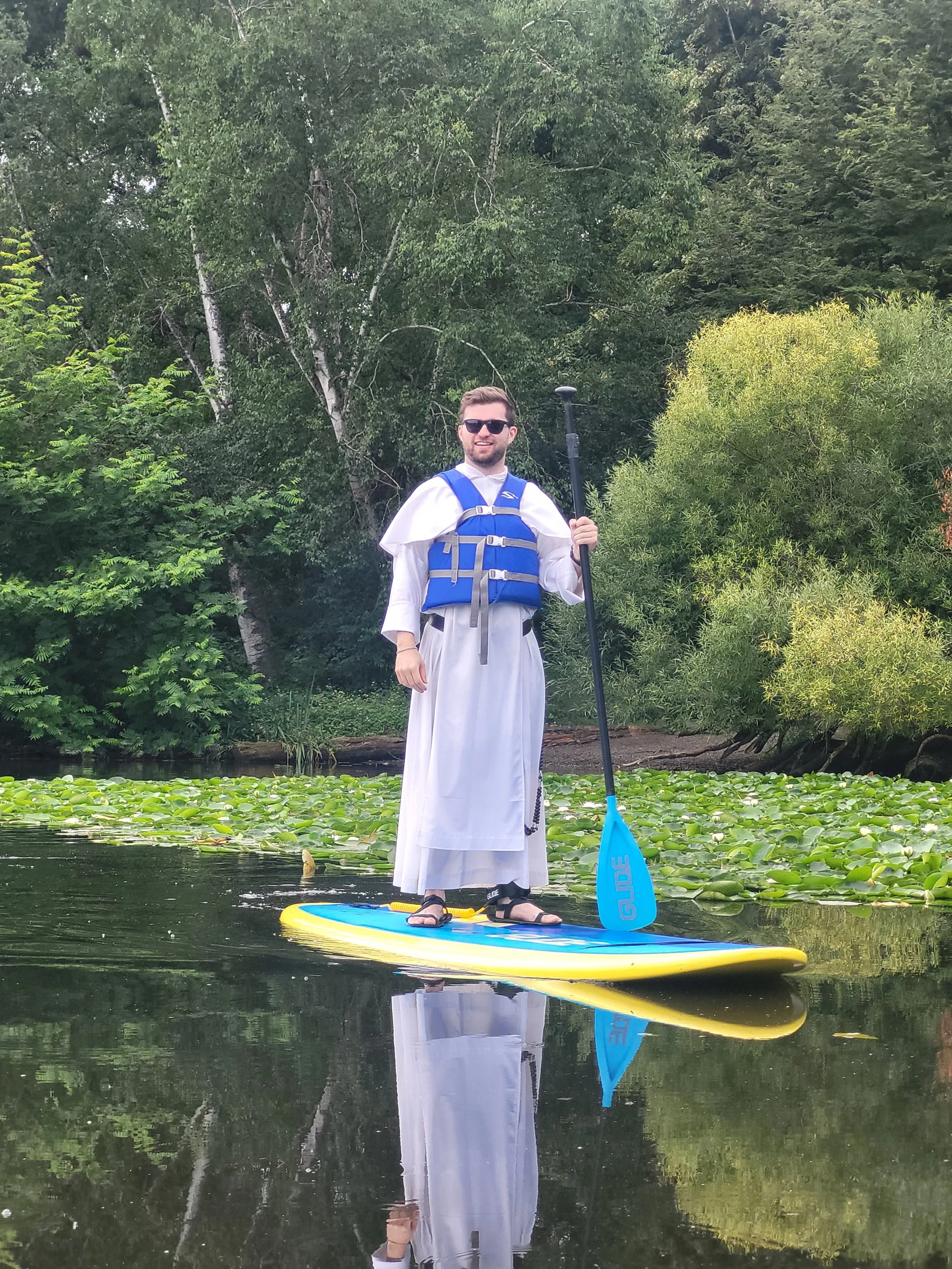
Lastly, here is a picture of me paddle boarding on Lake Union during my assignment in Seattle this past summer!
After my initial formation is complete, I will be assigned to full-time service at one of our parishes or university ministries. Perhaps I’ll have the opportunity to serve at Stanford! I’m increasingly convinced there’s something special about the culture at our alma mater. Fr. Chrysostom, assigned to Stanford in July, reported back to me his first impressions after a couple of weeks on campus: “Everyone I’ve met seems to be a different version of you.” Does Stanford select us all in some way alike? Or are we all shaped by our time spent on The Farm? Perhaps both these things are true.
What the Stanford student seeks in the Catholic faith hasn’t changed since I was an undergrad. Amidst a contemporary culture starved of meaning, they seek the perennial wisdom of the Catholic intellectual tradition. They seek the kind of friendship where two or more gaze together at the True and the Good and the Beautiful. Flooded with distractions, they seek the timeless experience of the Catholic Mass, where God Himself is made present in the Holy Eucharist. They will accept no substitutes for a life lived according to God’s eternal intention.
These aspects of our faith, which I deeply yearned for during my time at school, are now more prominent in the Catholic Community at Stanford. I see the beginnings of a profound renewal of Catholic life on campus; I am so optimistic about the direction of the community. As this year comes to a close, let us pray that the Holy Spirit may continue to set Stanford hearts on fire with love for God and neighbor. May others see their joy and follow them to Christ, the source of every blessing and fulfillment of all desire.